.svg)

The Spirit of May Day: Britain’s Celebration of Nature, Community and New Life
28
Apr
,
2026
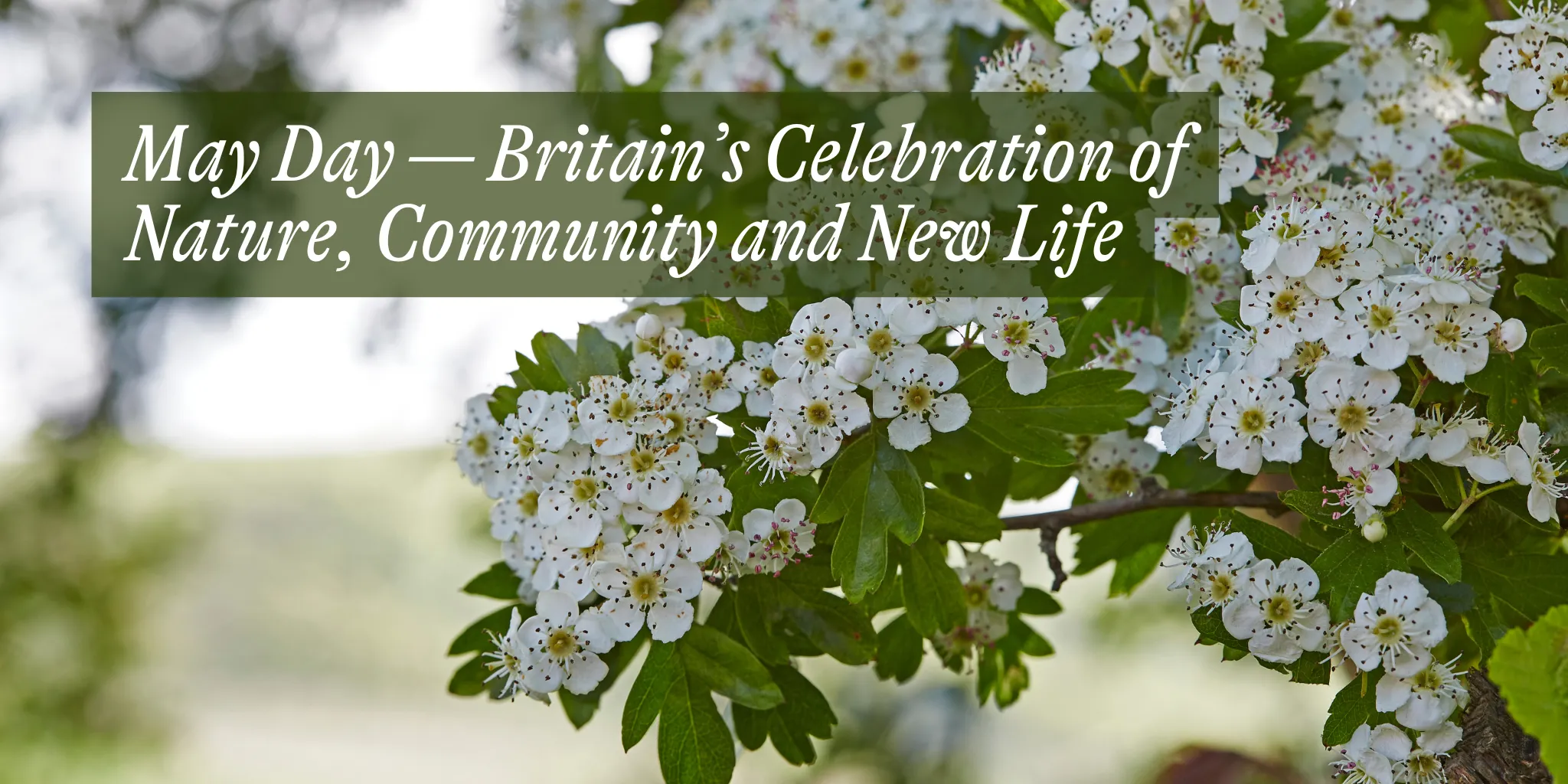


Walk into the hedgerows at the end of April and breathe in the scent of hawthorne
You can smell it before you see it — the strange, almondy, faintly fleshly perfume of hawthorn. The whitethorn is in flower. The land has tipped over into summer.
In Britain, the cross-quarter point between spring equinox and summer solstice is one of the four great hinges of the year. The Gaels called it Beltane, bright fire — the night the cattle were driven between two flames to bless them, when every household hearth was extinguished and rekindled from a single sacred bonfire shared by the whole community. In England, it became simply May Day. But the meaning was, and remains, the same: the world has caught fire with green, and we go out to meet it.
The Marriage of Earth and Sky
What is May Day really about? Beneath the ribbons and the morris bells lies an idea older than any of our religions: that the world is the child of a marriage between sky and earth.
In early May, the sun’s heat first penetrates the soil deeply enough to wake everything sleeping there. Sap rises. Birds nest. The blossom on the may-tree opens to the bee. To make sense of this, our ancestors gave it a story — the Sun courts the Earth, and where they meet, life pours out.
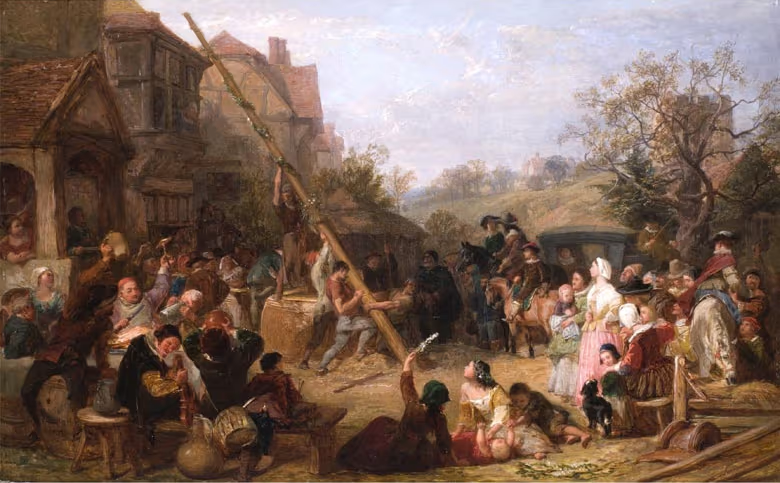
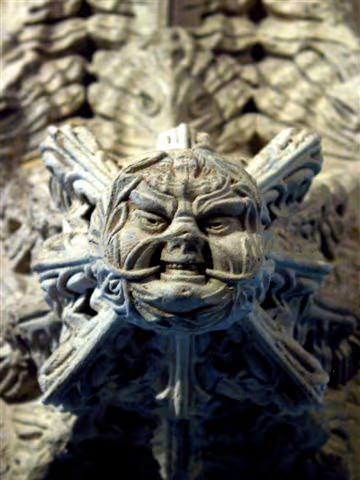
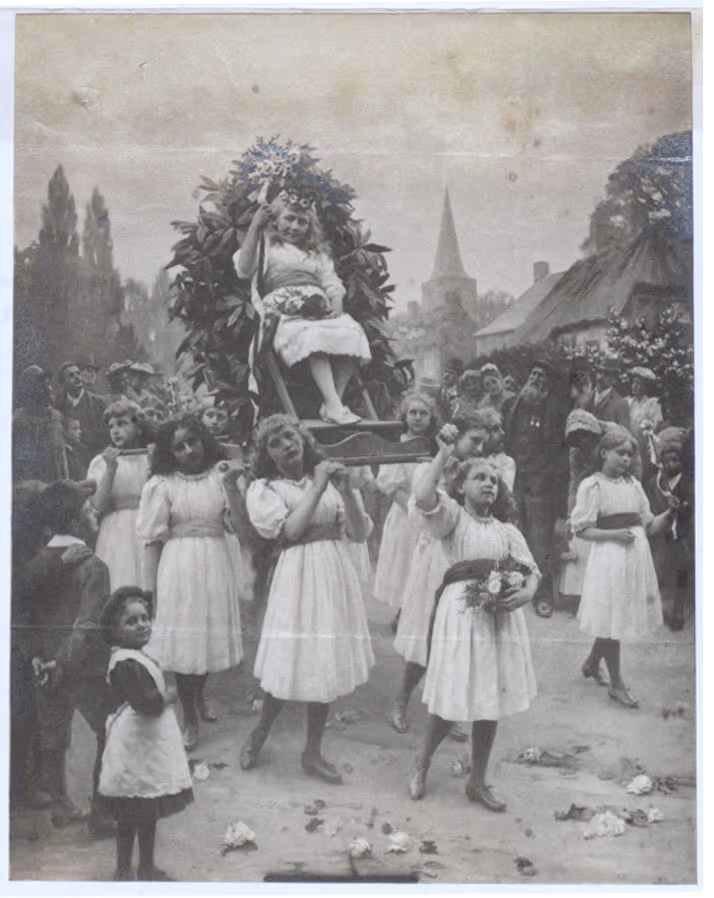
This is the deep grammar of every May Day custom we still keep. The Maypole is a sunbeam made of timber: a tall, straight rod driven into the soil — the sky’s lance entering the body of the world. The ribbons spiralling out from its crown are rays of light, woven by dancers into the helical pattern of growth itself. The Green Man, foliage spilling from his mouth, is the Earth answering the Sun. The May Queen, crowned in flowers, is the Earth in her bridal aspect. Even the bonfire — the bel-fire of Beltane — is a fragment of the sun, brought down to bless what walks beneath it.
This is why the festival has always made Puritans nervous. It is unembarrassed. It is fertile. The pamphleteer Philip Stubbes, writing in 1583, complained that of every hundred maids who went into the woods on May Eve, scarcely a third returned home as they had set out. He meant it as a horror. The villagers he was describing meant it as a blessing.
The Cast of the Greenwood
May Day’s mythology is carried by a strange, marvellous cast of characters — and they are all variations on the same theme.
There is the May King and May Queen, crowned in hawthorn and primrose, presiding over the revels. There is the Green Man — a man dressed in leaves and branches, sometimes encased entirely in a wickerwork cage of greenery, only his eyes visible — who still appears each year in towns from Hastings to Knutsford as Jack-in-the-Green. There is his older shadow, the Green Woman, less often dramatised but everywhere implicit: the wild feminine of the woods, the shepherdess Marion of the medieval pastourelles, who in England became Maid Marian. And there is Robin Hood.
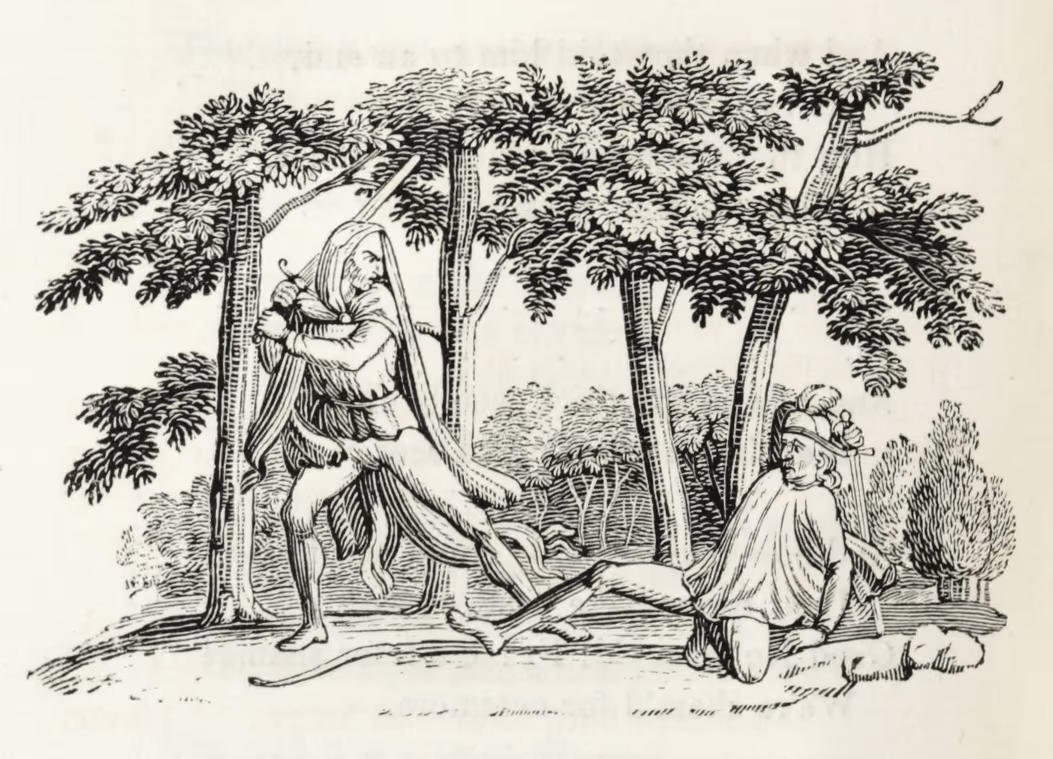
It comes as a surprise to most people that Robin Hood was, for centuries, the May King of England. Tudor parish accounts at Kingston-upon-Thames, Reading, Croscombe and Wells all record annual payments for “Robyn Hode” plays at May time, accompanied by Little John, Friar Tuck, Maid Marian and morris dancers. Henry VIII led his court out a-Maying dressed as Robin, two hundred yeomen in Lincoln green at his back; in 1510 he disguised himself as the outlaw to surprise Catherine of Aragon in her chamber. The Robin of these games may not be the historical outlaw of the ballads at all — he may be older, a wood-spirit Robin Goodfellow, the same impish green presence Shakespeare folded into A Midsummer Night’s Dream as Puck. Outlaw, fairy, archer of the greenwood: the figures blur into one another because they were always one figure.
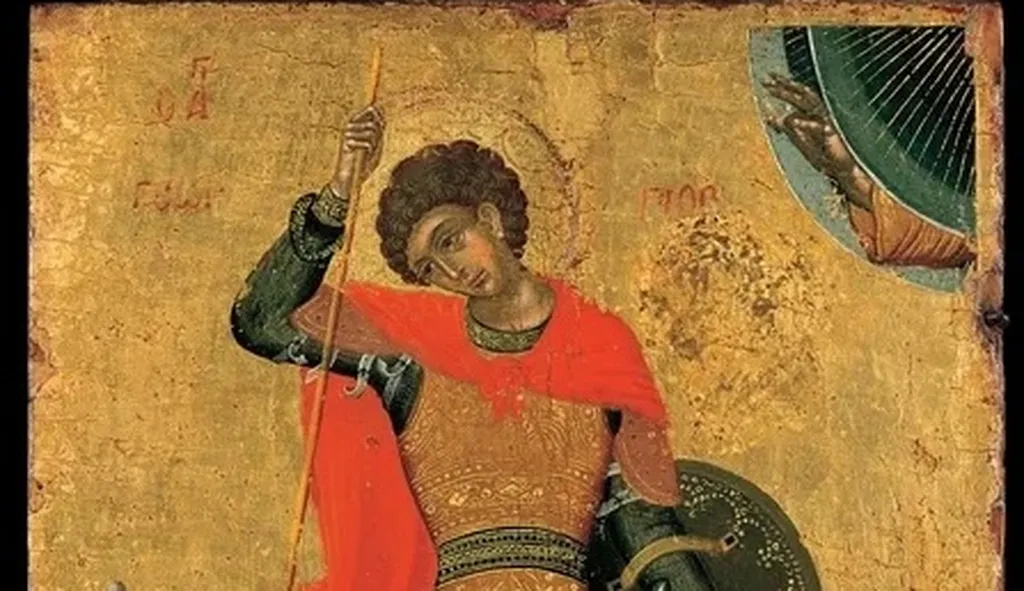
And then, woven into the same dance, comes St George.
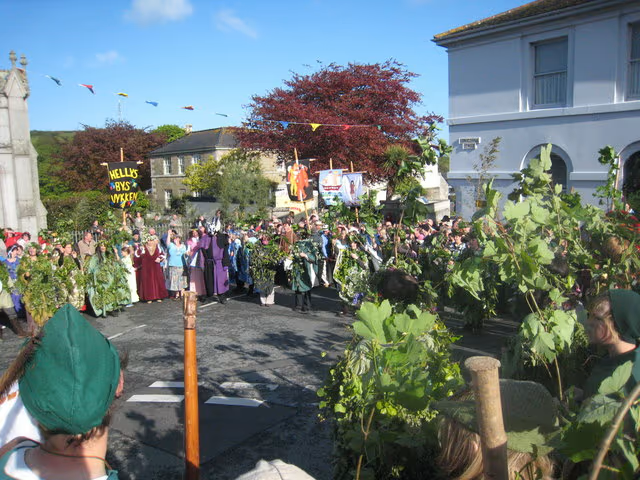
His feast day falls on 23rd April, just eight days before May Day, and his presence in May customs is unmistakable. The Hal-an-Tow song, sung in the streets of Helston each Furry Day, calls his name aloud. So does the Padstow May Day Song before the Obby Oss rides. In Helston, the May procession was once led by men dressed as St George, St Michael, Robin Hood, Friar Tuck and Little John — a single greenwood-and-dragon-slayer cast.
This makes more sense than it first appears. The dragon St George kills is the worm of winter — the cold, scaled thing coiled around the sleeping land. His lance is the same lance the Maypole is: a long straight rod driven into the earth, releasing the imprisoned waters and waking the soil. The fool with his bauble, the saint with his spear, the king in his greenwood, the bridegroom of summer — in May, they are all the same person.
There is even, in this archetype, a place for the Holy Fool. The Maypole is danced around by figures who deliberately tangle and untangle their lines, who lose themselves in the weave. The Fool’s role in folk tradition is to step into vulnerability, to risk looking ridiculous — and, in doing so, to come closest to the truth. May Day belongs to him as much as to the king.
The Welsh May Day: Gwyn, Gwythyr, and the Flower Bride
If you want the same story told plainly, the Welsh have it. The eleventh-century tale of Culhwch and Olwen, one of the four oldest pieces of Arthurian literature, contains what is almost certainly the most explicit Beltane myth surviving in any of these islands.
The fairest maiden in the Island of Britain is Creiddylad, daughter of the silver-handed god Lludd. She is betrothed to Gwythyr ap Greidawl — Gwythyr, Son of Scorcher — a knight of bright and ardent disposition. But before they can be married, Gwyn ap Nudd, lord of Annwn, leader of the Wild Hunt, king of the Welsh fairies, dark master of the otherworld, abducts her. Gwythyr raises an army to take her back. There is a battle, ferocious and cruel; Gwyn wins it, and does terrible things. Arthur intervenes. He releases the captives, returns Creiddylad to her father, and decrees the fate under which the two suitors must thereafter live: Gwyn and Gwythyr will fight, every first of May, until Doomsday, for the Flower Bride; and whoever wins the combat on the last day of the world will keep her forever.
This is the single clearest seasonal myth in the British corpus. Gwythyr is summer; Gwyn is winter; Creiddylad is the green world they fight over. Their ritual combat is Beltane — the eternal festival-day on which the King of Light wrestles the King of the Dark for possession of the Spring. In the Greek world the same story is Persephone, taken by Hades to the underworld and recovered each spring. The Welsh just put it on a fixed date and made the rivals fight forever.
Glastonbury keeps the same story under a different name. In the twelfth-century Life of Gildas by Caradoc of Llancarfan, a king called Melwas — lord of the Aestiva Regio, the Summer Country, which is to say Somerset — abducts Queen Guinevere and holds her on the Glass Island, identified explicitly as Glastonbury. Arthur comes with an army to retrieve her. A peace is brokered. In Malory’s later retelling the abduction takes place specifically while Guinevere is a-Maying in the woods with her ladies, all of them dressed in green. The same archetype, in Christianised dress: the dark king carries off the May Queen; the light king comes to fetch her home. The British Beltane is, at root, this story.
That every Maypole dance, every Padstow Obby Oss, every Helston Furry, every dawn climb up Glastonbury Tor is a continuation of Gwyn and Gwythyr’s eternal combat for the Flower Bride is a slightly mad thing to say. But it is also, demonstrably, true.
The fight has been going on for a thousand years of recorded telling, and probably much longer. We are still in it. May Day is the day we step into the ring.
The Bel-Fire
The festival’s older name, Beltane, points straight at its great central rite. Bel-tene — bright fire. The word is Gaelic, and may carry the name of a god, Belenus, the shining one; or it may simply mean what it sounds like, the fire that comes when the year tips bright. Either way, the central act of Beltane was always the same: kindling a sacred bonfire on a hill, and using it to bless what walked beneath.
The first written description we have is from the lost glossary of Cormac, the tenth-century bishop-king of Munster, who describes how the people of Ireland would build two great bonfires side by side and drive their cattle between them on the first of May, as protection against disease and the hidden harms of summer. The cattle had been wintered indoors, often in cramped and sickly conditions; Beltane was the day they were turned out to summer pasture. To pass them between the twin flames was to scour them with sun and smoke, and to consecrate the move outward into the open year.
But the fire was not only for the cattle. Across the Highlands and Hebrides, on the eve of Beltane every household hearth in the village was deliberately extinguished. A single new fire — the neid-fire, or need-fire — was kindled by friction from a piece of oak on the hilltop, and from this fire alone, every household relit its hearth. For the first night of summer, every home in the parish burned a fragment of the same flame. The community was, quite literally, of one fire. The cosmic union of sky and earth had its civic counterpart: the unity of the village under a single common light.
People leapt over the fire too. Lovers leapt together, hand in hand, to bless their match. Pregnant women leapt to ask easy births. Farmers leapt for prosperity, the young for sheer joy. The smoke was held to be cleansing, the leap itself a way of casting off the residue of winter. In the central Highlands, a special Beltane bannock — an oatcake — was sometimes baked at the fire and broken into nine knobs, each tossed over the shoulder into the flames with a charm asking each predator (wolf, fox, eagle, raven, marten) to spare the herd in turn. In some districts a portion of the bannock was deliberately blackened, hidden in a bonnet, and drawn for; the man or woman who drew the Cailleach Bealtaine, the burnt piece, was made to leap the bonfire three times — an echo of what was, in much older days, almost certainly something darker.
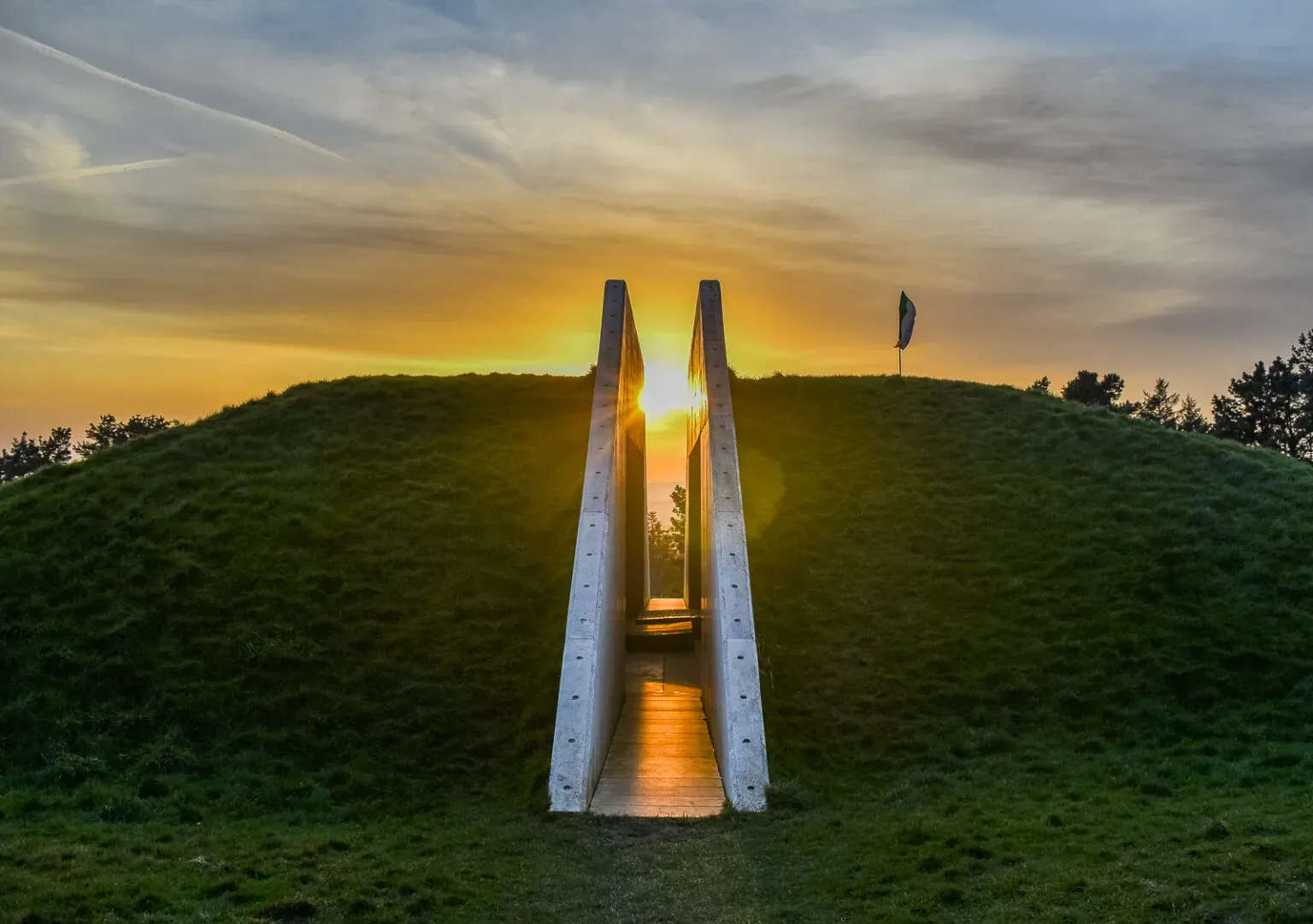
These hilltop bel-fires never quite went out. The Hill of Uisneach in County Westmeath — the mythic centre of Ireland — keeps its Beltane fire to this day. Edinburgh’s Calton Hill blazes each 30th April with the Beltane Fire Society’s procession, a crowd of thousands now where in 1988 there were fifty. Glastonbury Tor receives its dawn ceremony every year. The fragment of the sun is still being carried down the hillside.
The Maybush at the Threshold
If the Maypole is the great public symbol of May Day, the Maybush is its quiet domestic counterpart. Across Ireland, much of Wales, and once across most of England too, families would cut a flowering branch of hawthorn on May Eve and set it at the doorway, decorating it with ribbons, painted eggshells saved from Easter, primroses, and the bright yellow flowers of gorse — the colour of the returning sun. In Dublin and Belfast, neighbourhoods competed fiercely for the most splendid Maybush, and rival districts have been known to steal each other’s. In County Wexford, the tradition is alive and thriving today. The Maybush invites the wild across the threshold, welcoming the green into the home — while at the same time warding off whatever might wish the family ill on this thin night when the otherworld is felt to press close.
The hawthorn herself is the queen of British trees on May Day. To bring her flowers into the house at any other time of year is unlucky — even today, many country people quietly will not. But on May Day she is welcomed in. She is the fairy tree, the lone bush left standing when every other has been ploughed under, the tree the new road bends to avoid. She is what the festival is named for. The May is hawthorn blossom; going a-Maying means walking out before sunrise to gather it. To garland your door with a sprig of may is to mark your home as a place where the season has been welcomed in person.
The Hobby Horse, the Holy Well, and Other Customs of May
Around the great pillars of the festival — the Maypole, the Maybush, the bel-fire, the procession of the greenwood king and queen — a thousand smaller customs cluster, each with its own loyal following, some local to a single town, some carried right across these islands.
There is the hobby horse. In Padstow, on the Cornish north coast, the Obby Oss still rides each May Day with the singing of the May Song from midnight onwards: a fierce-looking masked dancer beneath a six-foot black hooped skirt, weaving through the streets to drumming and accordion until the small hours. In Minehead, on the Somerset coast a hundred miles east, the Sailor’s Horse and the Town Horse ride out for three days from May Eve. These hobby horses are extraordinary survivals — animal-spirits in human form, carrying summer through the streets in a great dance of welcome. They are first cousins to the wickerwork Jack-in-the-Green of Hastings and Knutsford, and to the chimney sweeps of London, who until the nineteenth century paraded a man-shaped bush of greenery through the city streets and asked for coin.
There is the holy well. From Madron in Cornwall to St Anthony’s Well below Arthur’s Seat in Edinburgh, May Day morning was always a day for going down to the spring before sunrise. The first water of the May was held to be specially blessed, and the first person to draw it was thought to take the well’s luck for the whole year. People left clooties — small strips of cloth — tied to the thorn trees that so often stand watch over a holy well, each one a prayer or a healing wish. The hawthorn over the spring, the cool stone basin, the slow trickle from the rock: these are pilgrim places, and Beltane is one of the great well-days of the British year.
There is May dew. Long before sunrise, women and girls would walk out into the wet grass and wash their faces in the dew of May Day morning, which was held to bring beauty and a fair complexion for the rest of the year. Catherine of Aragon collected dew on May Day in 1515. Samuel Pepys complained in his diary in 1669 that his wife and her maids had woken him at three in the morning to be off for it. In Edinburgh, until astonishingly recently, hundreds of women climbed Arthur’s Seat at four o’clock each May morning to catch the dew at dawn — and a few still do.
There is the garland. Branches of hawthorn fixed above the door; sprigs of rowan above the stable to keep its milk safe; primroses scattered along the threshold, a thin yellow line across which (it was said) no fairy could step. Each was a small defence against the otherworld at its most porous moment, and each a welcome to the season’s most hopeful flowers. In London, milkmaids once paraded on May Day morning with garlands of silverware borrowed from their employers, jingling through the streets in a custom now almost three centuries gone.
There is the bond. May Day was the great day of handfasting — the binding of a couple’s hands together with cord, in promise of marriage for a year and a day. The lunar month that followed was called the honey-moon, in part because the newlyweds were given mead, the honey-wine, to drink for the whole month, ensuring the sweetness — and the fertility — of their union. The English word for a wedding’s first month carries Beltane inside it.
And there are smaller things still. Children went barefoot on May Day for the first time in the year. Beekeepers moved their hives. Fishermen expected a good catch. Farmers planted turnips, and (according to one persistent strand of folklore) cucumbers — naked, for protection against blight. May Day in Britain has always been knee-deep in custom, much of it half-comic, half-serious, all of it a way of being precise about the strangeness of being alive at the door of summer.
The Songs That Carry the Year
May Day has its own music, and it is some of the oldest music we possess.
The thirteenth-century round known as the Reading Rota — better remembered by its first line, the famous one calling on the cuckoo to sing — is a May song, and the oldest English composition for which we have both words and notation. The Cornish Hal-an-Tow, processed through the streets of Helston each 8th May, announces the arrival of summer and the departure of winter, and runs through a roll-call of greenwood heroes — Robin Hood, Little John, St George, St Michael, even Aunt Mary Moses — whose presences are summoned to bless the year ahead.
The Padstow May Day Song, sung from midnight onwards as the Obby Oss readies to ride out, asks where St George has gone. Across the Pennines, the Swinton, Castleton and Cheshire May songs are still kept, sometimes mournful, sometimes raucous, all of them about the fetching home of summer.
These are not performances. They are working songs — and the work being done is to summon the season, give it permission, invite it across the threshold. In every one of them, summer is something that has to be brought home.
Going A-Maying: A Pilgrim Practice
This is where May Day becomes pilgrimage. To go a-Maying is the original British dawn walk: out before sunrise on the first of May, into the lanes and the wet hedges, to gather hawthorn and come back changed. It is a practice older than churches and parishes, and it is still entirely doable. You don’t need a costume, a hobby horse, or a permanent village Maypole. You need shoes, a willingness to be early, and a hedgerow.
A pilgrim walking on May Day morning is participating in something remarkably continuous. The Romans called it Floralia. The Gaels lit their bel-fires for it. Henry VIII rode out for it dressed as an outlaw. Puritans tried, and failed, to suppress it. And every year, somewhere in Britain — in Padstow, in Hastings, in Knutsford, on Glastonbury Tor, on Calton Hill in Edinburgh — someone is still climbing a hill before dawn to meet the sun.
To walk among the may-blossom on the first morning of May is to take your place in this long line. The Maypole, the bonfire, the green king and the flower queen — these are not relics. They are a living grammar for celebrating the fact of being alive on a fertile earth. The land does not need our ceremonies, but our bodies do. May Day reminds us of something pilgrimage has always known: that the world is best met on foot, at dawn, with a sprig of hawthorn in the hand.
Walk a green way this May Day. Sing what songs you know. Gather flowers at sunrise. Fetch the summer home.
Pilgrimages for May
A May pilgrimage is best taken in landscapes that flower, well up, or tip toward summer in some particular way. A few BPT routes that resonate strongly with the Beltane themes in this article are:
May Pilgrimages in England
- Glastonbury Pilgrimage in a Day — the cosmic centre of the British May, where the Maypole’s lance, the Tor’s tower, the twin springs and the hawthorn-shrine all meet on one hill.
- The North Downs Pilgrims' Way — through flowering woods and old pilgrim churches, the bluebells out and the may in full blossom.
- Worcester Cathedral Pilgrimage in a Day — across the Malvern Hills, famous for May bluebells and the long spring view.
May Pilgrimages in Wales
- St Winefride's Well Pilgrimage (Wales / Shropshire) — (Wales / Shropshire) — to the finest holy well in Britain, ending where Winefride’s spring still rises through the place her head is said to have fallen. May Day was always a holy-well day, and this is the well.
- The Lleyn Pilgrims’ Trail — the old pilgrims’ road to Bardsey, the Isle of the Setting Sun. Wales is where the deepest May Day myth in the British corpus comes from — Gwyn ap Nudd, Gwythyr, and Creiddylad — and this route carries you through the Brythonic landscape that produced it.
- Penrhys Pilgrimage Way — the old Cistercian Marian route up the Rhondda, recovered in living memory after the Reformation. Mary as Bride is one of the great May Day figures, and her well at Penrhys still flows.
May Pilgrimages in Scotland
- St Andrews Way (Edinburgh to St Andrews) — begins, by happy coincidence, at Britain’s most spectacular living Beltane site: Edinburgh’s Calton Hill, where the Beltane Fire Society’s procession still draws thousands every May Eve. Pilgrims setting out on May Day morning can climb Arthur’s Seat for the dawn dew first — a custom hundreds of Edinburgh women kept until very recently, and a few still do.
- St Columba’s Way (Iona to St Andrews) — across the Hebrides and the Highlands, through the very landscape where Cormac of Munster recorded the Beltane fires of cattle and bonfire-leaping.
- Whithorn Way (Glasgow to Whithorn) — a fortnight’s walk to St Ninian’s chapel above the Irish Sea, through holy wells and abbeys, in some of the gentlest May country in Britain.
Traditional May Song, sung by Guy Hayward
Summer is Here, sung by Guy Hayward
Oxford May Morning
.svg)
_-_geograph.org.uk_-_1287327_.avif)

Further reading

.svg)
Comments
0 Comments
Login or register to join the conversation.
Tom Jones
Lorem ipsum dolor sit amet, consectetur adipiscing elit. Suspendisse varius enim in eros elementum tristique. Duis cursus, mi quis viverra ornare, eros dolor interdum nulla, ut commodo diam libero vitae erat. Aenean faucibus nibh et justo cursus id rutrum lorem imperdiet. Nunc ut sem vitae risus tristique posuere.
Tom Jones
Lorem ipsum dolor sit amet, consectetur adipiscing elit. Suspendisse varius enim in eros elementum tristique. Duis cursus, mi quis viverra ornare, eros dolor interdum nulla, ut commodo diam libero vitae erat. Aenean faucibus nibh et justo cursus id rutrum lorem imperdiet. Nunc ut sem vitae risus tristique posuere.