

Cornish Celtic Way
Southwest England


Why walk the Cornish Celtic Way
Walk across Cornwall in the footsteps of its saints. The Cornish Celtic Way runs 125 miles from St Germans Priory, once the cathedral of Cornwall, to St Michael's Mount, rising from the sea in Mount's Bay. It follows the south coast past Looe Island and Polperro to Fowey, crosses the county on the ancient Saints' Way to Padstow, then runs down the Atlantic coast before taking St Michael's Way to the Mount.
On the way you pass holy wells, Celtic crosses, Neolithic hilltops, an oratory buried in the dunes and dozens of medieval churches. With a Cornish Celtic Way Passport you can sleep on the floors of more than 25 churches and church halls, usually for £10–15 a night.
The Celtic saints found God in sea, stone and spring, and this Way invites you to look for the sacred in the same places. You don't need to be religious to walk it. National Geographic Traveller named it one of the seven best pilgrimages in the UK in 2025.
- Begin beneath the Norman doorway of St Germans Priory, seat of Cornwall's Saxon bishops, and its Burne-Jones east window
- Look out to Looe Island, where Benedictine monks from Glastonbury kept a chapel
- Pause in St Wyllow's, Lanteglos-by-Fowey, where Daphne du Maurier was married
- Cross the county on the Saints' Way, over Neolithic Helman Tor and past the ancient crosses of Lanivet
- Touch the water at St Constantine's Well and the tidal cave well at Holywell Bay
- Stand at St Piran's Cross in the dunes, where Cornwall's patron saint is remembered
- Arrive across the causeway at St Michael's Mount as the tide draws back
Route at a glance
- Distance: 125 miles (201 km), one way
- Time: 12 days at about 10 miles a day, or 14–16 days following the guidebook's 16 shorter walks
- Start: St Germans Priory, near St Germans station
- Finish: St Michael's Mount, Marazion, a short bus ride from Penzance station
- Climbing: up to 4,000 m (13,000 ft) of ascent in total, most of it on the coast path
- Difficulty: hard as a whole, for its length and steep coastal climbs. Most single days are moderate
- Made of: over 60 miles of the South West Coast Path, the Saints' Way and St Michael's Way
- Where you sleep: church floors and halls for Passport holders, plus YHA hostels, B&Bs and campsites
- Passport and guidebook: Passport £7, guidebook A Cornish Celtic Way £16, or both for £22, from the Cornish Celtic Way shop
- Best time: spring to early autumn, when the church accommodation is normally open
- Crossings: a foot ferry at Fowey, and a tidal crossing of the Gannel at Newquay
Suggested 12-day itinerary
Each day averages about 10 miles (16 km).
- Day 1: St Germans – Downderry – Looe. Sleep in Looe, or at Downderry for a shorter day
- Day 2: Looe – Talland – Polperro – Lansallos – Lanteglos – Polruan. Sleep at Polruan
- Day 3: Polruan – ferry to Fowey – Tywardreath – Par – Luxulyan. Sleep at Tywardreath or Luxulyan
- Day 4: Luxulyan – Helman Tor – Lanivet – Withiel. Sleep at Withiel or Lanivet
- Day 5: Withiel – St Issey – Little Petherick – Padstow. Sleep at Padstow
- Day 6: Padstow – Trevone – Trevose Head – Constantine Bay – Treyarnon. Sleep at Treyarnon or St Merryn
- Day 7: Treyarnon – Porthcothan – Bedruthan Steps – Mawgan Porth – St Mawgan. Sleep at St Mawgan or St Eval
- Day 8: St Mawgan – Watergate Bay – Newquay – the Gannel – Crantock. Sleep at Crantock
- Day 9: Crantock – Holywell Bay – St Piran's Oratory – Perranporth – St Agnes. Sleep at St Agnes or Perranporth
- Day 10: St Agnes – Porthtowan – Portreath. Sleep at Portreath (a shorter day after the steepest coast path)
- Day 11: Portreath – Godrevy – Gwithian – Phillack – Hayle – Lelant. Sleep at Gwithian, Phillack or Carbis Bay
- Day 12: Lelant – Trencrom Hill – Ludgvan – Marazion – St Michael's Mount. Sleep at Marazion or Ludgvan
Walk it in sections
- The south coast: St Germans to Polruan, 2–3 days. Start from St Germans station
- Coast to coast on the Saints' Way: Polruan to Padstow, 3–5 days
- The Atlantic coast and St Michael's Way: Padstow or Newquay to St Michael's Mount, 5–7 days
The story of the Way
Saints from the sea. Between about 500 and 600 AD, holy men and women from Wales, Ireland and Brittany settled in Cornwall. They built cells by springs, on headlands and in the dunes, and their names are still on the map: Petroc at Padstow, Carantoc at Crantock, Piran at Perranporth, Constantine at Constantine Bay, Gothian at Gwithian, and Uny at Lelant.
Petroc and the king. St Petroc was born in Wales around 468 and founded a monastery on the Camel estuary; Padstow means Petroc's stow, or holy place. Legend says he tamed a wolf and saved a stag from the hunt of King Constantine, who was so moved that he became a Christian. Constantine Bay, on Day 6, keeps the king's name.
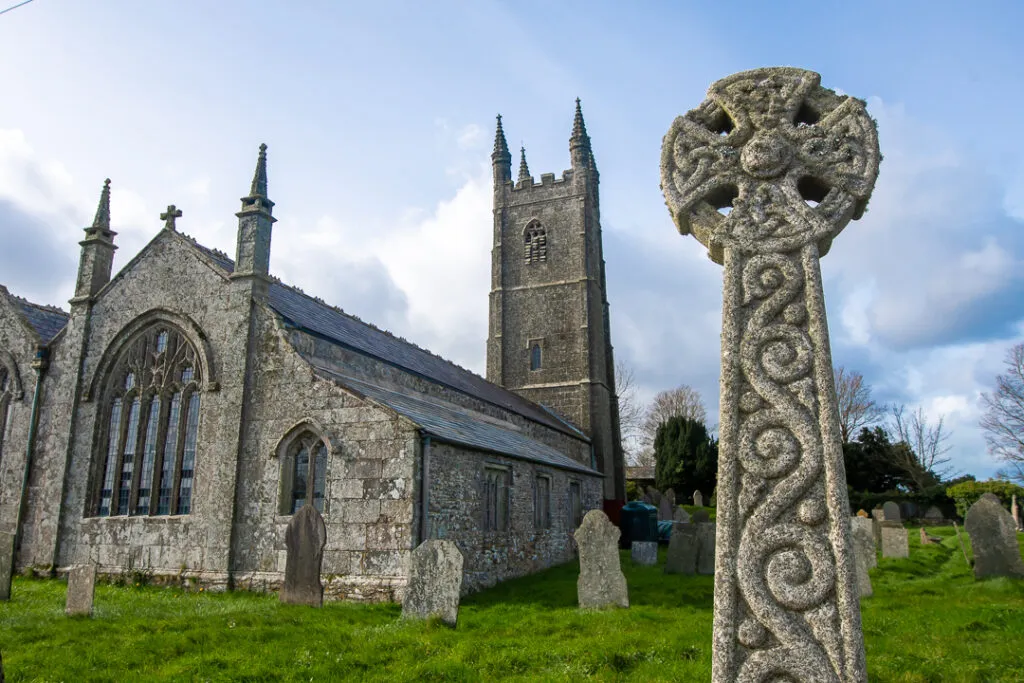
Piran in the dunes. St Piran, patron saint of Cornwall and of its tinners, is remembered at Penhale Sands. His oratory there was lost under the sand, uncovered in 1835, buried again, and dug out once more in 2014. Beside it stands St Piran's Cross, thought to be the earliest recorded stone cross in Cornwall. Every 5 March, St Piran's Day, people process across the dunes to the cross.
A path across the peninsula. The Saints' Way, from Padstow to Fowey, is said to follow the way travellers from Ireland and Wales crossed Cornwall rather than sail round Land's End. It was revived in 1984 after walkers found a forgotten line of granite stiles. St Michael's Way, from Lelant to the Mount, was created after records showed pilgrims landing at Lelant on their way to Santiago de Compostela. It is now recognised as part of the European network of Camino routes.
Cathedral and Mount. In the 10th century King Athelstan made St Germans the seat of a bishop for Cornwall, and the great Norman priory church that followed served for a time as the county's cathedral. At the other end of the Way, legend says St Michael appeared to fishermen on the Mount in 495. By 1066 the island belonged to the Benedictine abbey of Mont-Saint-Michel in Normandy, and monks began its summit church in 1135.
A new pilgrimage. Revd Nigel Marns devised the Cornish Celtic Way by linking more than 60 miles of coast path with the Saints' Way and St Michael's Way. He set it out in 16 walks in his guidebook, A Cornish Celtic Way, and a festival of walking along the route in May 2018 brought it wider notice. Volunteers in churches along the Way open their floors to pilgrims, and money from the book and Passport goes back into the project. Its aim is to help people of all ages explore faith in a different way: outdoors, in the landscape the saints loved.
The route, day by day
Each day averages about 10 miles. Church accommodation is listed in the Accommodation List that comes with your Passport, so you book it directly with each church.
Day 1: St Germans to Looe
Start at St Germans Priory. Its west front has a seven-arched Norman doorway, and its east window was made by Morris & Co to designs by Edward Burne-Jones in 1896. Walk through farmland to the sea at Seaton and Downderry, then take the coast path to Looe, with Looe Island ahead of you.
- Holy places: St Germans Priory · St Nicolas, Downderry · Looe Island, seen from the cliffs
- Sleep: St Germans Priory (if you arrive the night before), St Nicolas, Downderry, or Riverside United Church, Looe
- Getting there and away: trains to St Germans and from Looe; buses between Downderry and Looe
Day 2: Looe to Polruan
One of the loveliest stretches of the south coast, by Talland Bay, the fishing village of Polperro and the beach at Lansallos, to the hilltop church of Lanteglos and down to Polruan on the Fowey estuary.
- Holy places: Talland church, above its bay · St Ildierna's, Lansallos, with carved wagon roofs, a Norman font carved with a tree of life, and 16th-century bench ends · St Wyllow's, Lanteglos-by-Fowey, where Daphne du Maurier was married in 1932
- Sleep: Polruan Village Hall, or Sclerder Abbey at Talland for a shorter day
- Take care: steep climbs and descents on the coast path
- Getting there and away: buses between Looe, Polperro and Polruan
Day 3: Polruan to Luxulyan
Cross the estuary on the foot ferry to Fowey, then leave the coast. Walk inland to Tywardreath, once home to a Benedictine priory, and on through Par into the wooded Luxulyan Valley, past the granite arches of the Treffry Viaduct.
- Holy places: St Fimbarrus, Fowey, with a fine 15th-century wagon roof and a Norman font · St Andrew's, Tywardreath, which keeps carved stones from the lost priory · St Cyriacus and St Julitta, Luxulyan, a granite church with a holy well nearby
- Sleep: Tywardreath Chapel, or a B&B in Tywardreath
- Take care: the Polruan–Fowey foot ferry runs daily except Christmas Day
- Getting there and away: Par station on the main line
Day 4: Luxulyan to Withiel
The heart of the Saints' Way. Climb Helman Tor, a granite ridge walled by Neolithic people about 6,000 years ago, with rocking stones on its crest. Continue to Lanivet, where a churchyard cross is said to mark the centre of Cornwall, and on to Withiel.
- Holy places: Helman Tor · Lanivet churchyard, with two ancient crosses and a rare Viking-style hogback grave · St Clement's, Withiel
- Sleep: St Clement's, Withiel, or Lanivet Methodist Church
- Take care: stiles and cattle on inland fields
Day 5: Withiel to Padstow
Cross quiet farmland to St Issey and Little Petherick, then follow the Camel estuary into Padstow, the town that grew around St Petroc's monastery.
- Holy places: St Issey, named for one of the many saintly children of the Welsh king Brychan, with a carved reredos of local Catacleuse stone · St Petroc Minor, Little Petherick, where Ninian Comper made the rood screen and high altar · St Petroc's, Padstow, with a 15th-century carved font
- Sleep: St Petroc's Church Hall, Padstow (book 14 days ahead), the Osbourne Room at St Issey, or Little Petherick Village Hall
- Getting there and away: buses from Padstow to Newquay
Day 6: Padstow to Treyarnon
Walk out past the mouth of the Camel and round Trevose Head to Constantine Bay. On the golf course, a public footpath leads to the ruins of St Constantine's chapel and his holy well.
- Holy places: St Constantine's Well and chapel ruins · St Merryn church, whose font, carved with the twelve apostles, came from St Constantine's chapel
- Sleep: YHA Treyarnon Bay, or St Merryn Church Hall
- Take care: the wellhouse is flooded and cannot be entered; touch the water at the spring
Day 7: Treyarnon to St Mawgan
A day of great beaches and cliffs: Porthcothan, the rock stacks of Bedruthan Steps and Mawgan Porth. Then turn inland up the Vale of Lanherne to St Mawgan.
- Holy places: St Eval, whose tower was repaired in 1727 as a landmark for sailors · St Mawgan-in-Pydar, with the best-preserved medieval lantern cross in Cornwall · the Lanherne cross, in the grounds of the convent next to the church
- Sleep: St Mawgan-in-Pydar church (up to four pilgrims), or St Eval Church Hall
Day 8: St Mawgan to Crantock
Rejoin the coast at Watergate Bay and walk through Newquay. Cross the Gannel estuary to Crantock, where tradition says Celtic missionaries founded an oratory in 460.
- Holy places: St Carantoc's, Crantock, with a Norman font and a restored rood screen
- Sleep: St Carantoc's Church Hall, Crantock (book 14 days ahead)
- Take care: the Gannel foot ferry runs only at high tide, from mid-May to mid-September. At other times, check the tide before you cross
- Getting there and away: Newquay station
Day 9: Crantock to St Agnes
Descend to Holywell Bay and its two holy wells, then cross Penhale Sands to St Piran's Oratory and Cross before reaching Perranporth. The coast path climbs on to St Agnes.
- Holy places: the two holy wells at Holywell Bay, one on the golf course and one in a sea cave · St Piran's Oratory and St Piran's Cross · St Agnes church, with a medieval wayside cross at its gate · St Agnes Beacon above
- Sleep: St Agnes church (vestry or hall), or St Michael's Church Hall, Perranporth
- Take care: the cave well can only be reached about two to three hours either side of low tide · the oratory is hard to find in the dunes, so follow the white markers from the National Trust gate
- Getting there and away: buses between Newquay, Perranporth and St Agnes
Day 10: St Agnes to Portreath
A short but steep day along the mining coast, past the engine houses of Chapel Porth and Porthtowan, now part of a World Heritage Site.
- Sleep: St Mary's Hall, Portreath
- Take care: the steepest coast path on the Way. Consider a luggage transfer for this stretch
Day 11: Portreath to Lelant
Walk the cliffs to Godrevy, with its lighthouse offshore, then cross the dunes to Gwithian. Round the Hayle estuary by Phillack and Hayle to Lelant, where St Michael's Way begins.
- Holy places: St Gothian's, Gwithian, near the sand-buried remains of the saint's early chapel · Phillack church, with a chi-rho stone over its door that may date from the 5th century · St Uny's, Lelant, with ancient crosses in its churchyard
- Sleep: St Gothian's Church Hall, Gwithian, the Old Vestry at Phillack (from 1 May), or St Anta Church Hall, Carbis Bay
- Getting there and away: Hayle and Lelant stations
Day 12: Lelant to St Michael's Mount
The last day follows St Michael's Way inland. Climb Trencrom Hill, a Neolithic enclosure later used as an Iron Age fort, for views of both coasts and the Mount. Descend by Ludgvan to Marazion, and cross the causeway when the tide allows.
- Holy places: Trencrom Hill, with its Giant's Well · Ludgvan church and its Cornish crosses · St Michael's Mount
- Sleep: Murley Hall, Ludgvan, or in Marazion
- Take care: the causeway is only open around low tide
- Getting there and away: buses from Marazion to Penzance station
Holy places along the Way
On this Way, holiness lives in sea and sand, stone and spring, as much as in churches. This list follows the walking order.
Priories, islands and the Mount
- St Germans Priory: Cornwall's cathedral church in Saxon times, with a great Norman west front and a Burne-Jones east window. More about St Germans Priory
- Looe Island: once St Michael's Island, where Benedictine monks from Glastonbury kept a chapel. Local legend says Joseph of Arimathea landed here with the young Jesus. Now a nature reserve, visited only by the Cornwall Wildlife Trust's boat
- Tywardreath: site of a Benedictine priory, suppressed in 1536
- Lanherne, St Mawgan: a convent since 1794, with one of Cornwall's finest carved crosses in its grounds
- St Michael's Mount: a Benedictine priory, castle and church on a tidal island (see A closer look, below)
Churches on the route
- St Germans Priory (night sanctuary): seven-arched Norman doorway; Burne-Jones windows
- St Nicolas, Downderry (night sanctuary)
- Talland church: above Talland Bay
- St Ildierna's, Lansallos: wagon roofs, tree-of-life font, 34 old bench ends
- St Wyllow's, Lanteglos-by-Fowey: 14th-century church where Daphne du Maurier married
- St Fimbarrus, Fowey: 15th-century carved roof and Norman font
- St Andrew's, Tywardreath: carved stones from the lost priory
- St Cyriacus and St Julitta, Luxulyan: 15th-century granite church
- Lanivet church: two ancient crosses and a hogback grave
- St Clement's, Withiel (night sanctuary)
- St Issey (night sanctuary): Catacleuse stone reredos and Pietà
- St Petroc Minor, Little Petherick (village hall is a night sanctuary): Comper rood screen
- St Petroc's, Padstow (church hall is a night sanctuary): 15th-century font
- St Merryn (church hall is a night sanctuary): apostle font from St Constantine's chapel
- St Eval (church hall is a night sanctuary): tower kept as a sea mark
- St Mawgan-in-Pydar (night sanctuary): medieval lantern cross and carved rood screen
- St Carantoc's, Crantock (church hall is a night sanctuary)
- St Michael's, Perranporth (church hall is a night sanctuary)
- St Agnes (night sanctuary): medieval wayside cross at the gate
- St Mary's, Portreath (church hall is a night sanctuary)
- St Gothian's, Gwithian (church hall is a night sanctuary): Cornish cross in the churchyard
- St Felicitas, Phillack (the Old Vestry is a night sanctuary): chi-rho stone and an inscribed early memorial stone
- St Uny's, Lelant: start of St Michael's Way; four crosses in the churchyard
- St Anta, Carbis Bay (church hall is a night sanctuary)
- Ludgvan church (Murley Hall is a night sanctuary): two Cornish crosses in the churchyard
- All Saints, Marazion (church hall is a night sanctuary)
Holy wells
- Luxulyan: a 15th-century well house near the church
- St Constantine's Well, Constantine Bay: an early wellhouse on the golf course; touch the water at the spring. More about St Constantine's Well
- Holywell Bay: two wells linked to St Cubert, one in a gully near the golf course and one a cascade of pools in a sea cave, reached at low tide. More about the wells
- The Giant's Well, Trencrom Hill: a spring on the hill's western rampart
Crosses and carved stones
- St Piran's Cross, Penhale Sands: thought to be Cornwall's earliest recorded stone cross. More about St Piran's Oratory and Cross
- Lanivet: crosses and a hogback grave in the churchyard
- St Mawgan and Lanherne: a medieval lantern cross and the Lanherne cross
- Phillack: a chi-rho stone that may date from the 5th century
- Lelant and Ludgvan: churchyard crosses and wayside crosses
Hills, headlands and ancient places
- Helman Tor: Neolithic walls, rocking stones and wide views over mid-Cornwall
- Trevose Head: the headland above Constantine Bay
- St Piran's Oratory: an early chapel in the dunes, buried and uncovered more than once
- St Agnes Beacon: Bronze Age barrows and an old beacon site
- Trencrom Hill: a Neolithic tor enclosure and Iron Age fort, with views of both coasts and the Mount
Sea, sand and rivers
- Looe Island and Talland Bay on the south coast
- The Fowey and Camel estuaries, which mark the start and end of the Saints' Way
- The Luxulyan Valley, wooded and full of old granite workings
- Bedruthan Steps, Penhale Sands and the Hayle Towans on the Atlantic coast
- Godrevy Lighthouse, said to have inspired Virginia Woolf's To the Lighthouse
- Mount's Bay and the tidal causeway
Worth a detour
Golant, St Sampson's church and holy well on the Saints' Way · Bodmin, home to St Petroc's ivory casket · St Ives, the town of St Ia · Madron and Sancreed holy wells, near Penzance
Pilgrim practices to try on this Way
A pilgrimage is a walk with purpose, made on your own terms and needing no set beliefs. These practices help turn miles into meaning. Try any that speak to you, and if one does not feel right, do something else instead.
- Set an intention. Dedicate the journey to something you want help with, or to giving thanks. Try it under the Norman doorway of St Germans Priory, before your first step
- Carry a contact relic. Bring a small stone or shell from home and touch it to holy things along the way: St Piran's Cross, the crosses at Lanivet, each holy well. Carry it all the way to the Mount
- Touch the old crosses. Lay a hand on Cornwall's Celtic stone crosses as you pass, as the route's guidebook suggests
- Walk in silence. Tread quietly through the Luxulyan Valley woods and across the fields of the Saints' Way
- Walk slowly. Pace matters less than attention
- Circle a church before entering. Walk round it once, then pause in the porch before crossing the threshold
- Light a candle in any church where candles are offered
- Kneel, or lie down and look up. Kneel at the altar and think about what matters, or lie on the floor and gaze at the carved wagon roofs of Lansallos and Fowey
- Sing, or read a poem aloud. Try the great priory church at St Germans, or a tiny chapel where your voice fills the space
- Visit the holy wells. Touch the water, bless yourself with it, or wash your face and hands at St Constantine's Well and the wells of Holywell Bay
- Immerse yourself in the sea, imagining yourself washed clean. Swim only at lifeguarded beaches in season, and never alone
- Walk barefoot on the sand of Penhale, Constantine Bay or the Hayle Towans
- Look at the sky. Lie back on Helman Tor or Trencrom Hill and let the clouds move through you
- Watch the tide. Time your last steps to cross the causeway to St Michael's Mount as the sea draws back; it makes a natural threshold
- Take a holy nap in a quiet pew in any church you pass
- Join the prayers of others at a Sunday service along the way, or on the Mount in summer
- Sleep in sanctuary. Say a night prayer before sleep on the church floor, and wake with the light through the windows
- Collect stamps in your Cornish Celtic Way Passport as you go
- Give. Leave a donation, sign the visitors' book, and buy from local shops, cafés and pubs
- Keep the old feasts: St Piran's Day, 5 March, with its procession across the dunes to his cross · St Constantine, 9 March · St Petroc, 4 June · St Michael, 29 September
- Arrive. On the Mount, give thanks, and record your arrival with your final Passport stamp
- Carry it home. Give yourself time to reflect in the weeks afterwards
Pilgrimage with the British Pilgrimage Trust is open to all. Bring your own beliefs.
A closer look: St Michael's Mount
The Mount is the goal of the Way, and of St Michael's Way before it. It comes into view from Trencrom Hill and stays with you as you walk down to Marazion.
Its story. Legend says the Archangel Michael appeared to fishermen on the western side of the rock in 495, warning them of danger. By the Norman Conquest the island belonged to the Benedictine abbey of Mont-Saint-Michel, its twin across the Channel. Building of the priory church on the summit began in 1135, and the church was largely rebuilt in the late 14th century. Look for the medieval lantern cross, which shows a king who may be Edward the Confessor; by some accounts he gave the Mount to Mont-Saint-Michel.
Getting across. At low tide you walk over the causeway from Marazion. Check the tide times on the St Michael's Mount website before your last day, and plan to arrive as the sea draws back.
Visiting. In winter (November to mid-March) the harbour, village, shops and cafés are free to visit, but the castle and gardens are closed. In the main season, castle entry normally needs a ticket booked in advance. The summit church is closed for 2026 and reopens on 21 March 2027.
Worship. In summer the Mount holds Sunday services, and a service on St Michael's Day, 29 September. Pilgrims and groups who want to visit for prayer can arrange it through the Mount's office.
Your final stamp. Show your Cornish Celtic Way Passport at the Harbour Entrance Office for the last stamp of your journey.
A practice for this place. Pause on the causeway, halfway between land and island. Look back at the way you have come, then walk on to the Mount.
Practical information
The Passport and church accommodation
- Buy a Cornish Celtic Way Passport (£7). It comes with the Accommodation List: the churches and halls that host pilgrims, and how to book each one.
- Book each night directly with the church, ideally 7–14 days ahead. Some, such as Crantock and Padstow, ask for 14 days.
- Expect to pay about £10–15 per person per night. Volunteers run these places, and each takes only one booking a night: they are not hostels.
- Bring a sleeping mat and sleeping bag. Facilities vary from a cold tap and outside toilet to a full kitchen.
- Under-18s must be with an adult.
Some churches on the Way are also part of our Sanctuary Network and can be booked by Giving Pilgrims too.
Other places to stay
YHA Treyarnon Bay and YHA Penzance, a hostel at Perranporth, campsites along the coast, and B&Bs in Tywardreath, Lanivet and elsewhere. The Cornish Celtic Way's stay page lists them.
The guidebook
A Cornish Celtic Way by Revd Nigel Marns (£16) has step-by-step directions and maps for all 16 walks, with the stories of the saints. Buy it with the Passport for £22 from the Cornish Celtic Way shop. Route changes since the 2019 edition are posted on the route page.
Getting there and around
- Trains: St Germans (start), Looe, Par, Newquay, Hayle, Lelant and Penzance (near the finish)
- Buses: link Downderry, Looe, Polperro and Polruan on the south coast; Padstow, Newquay, Perranporth and St Agnes on the north coast; and Lelant, Marazion and Penzance in the west
- Luggage transfer: Luggage Transfers, based in Helston, can move your bags. It is worth it for the steep coast between Perranporth and Portreath
- From Newquay Airport: take the bus to Newquay
Ferries and tides
- Fowey: the foot ferry from Polruan runs daily except Christmas Day
- The Gannel, Newquay: a foot ferry runs at high tide from mid-May to mid-September. At other times, check the tide before you cross
- Holywell Bay cave well: reachable only about two to three hours either side of low tide
- St Michael's Mount: the causeway opens only around low tide
Finding your way
The South West Coast Path, the Saints' Way and St Michael's Way each have their own waymarks. Carry the guidebook or the GPX for the links between them. Download the GPX, or follow the route on OS Maps, Komoot or Outdooractive. New to this? Read our guide on how to navigate a pilgrimage route.
Staying safe
- Coast path sections depend on the weather. In late autumn and winter expect gales on the cliffs and mud inland, and choose shorter days.
- Expect stiles, cattle and steep climbs, especially on the coast.
- Keep dogs away from cattle, especially cows with calves and bulls. Most church accommodation welcomes dogs if you ask first.
- Mobile signal comes and goes. Tell someone your plans each day.
- Swim only at lifeguarded beaches in season, and never alone.
When to go
Spring to early autumn, when the church accommodation is normally open. May brings wild flowers on the cliffs; September brings quieter paths and the warmest seas. Walkers who come on 5 March can join the St Piran's Day procession across the dunes.
Walk with others
The Cornish Celtic Way runs group walks along the route. See its website for dates, and our events page for guided pilgrimages.
Frequently asked questions
Do I need to be religious?
No. The Way follows the Celtic saints, but anyone can walk it and find their own meaning.
How long is the Cornish Celtic Way?
125 miles (201 km) from St Germans to St Michael's Mount. Most people take 12 to 14 days.
Do I need the Passport?
Only if you want to sleep in the churches and church halls. It also gives you a record of your journey in stamps.
How much does it cost?
Church floors cost about £10–15 a night. The Passport is £7 and the guidebook £16.
Can I walk just part of it?
Yes. It divides naturally into the south coast, the Saints' Way across the county, and the Atlantic coast to the Mount.
Is it waymarked?
Most of it follows waymarked paths. Carry the guidebook or GPX for the links between them.
How fit do I need to be?
You need to walk about 10 miles a day, with steep climbs on the coast path. Shorter days are possible if you follow the guidebook's 16 walks.
Can I bring my dog?
Yes, with care around livestock. Most church accommodation accepts dogs if you ask when you book.
Can I walk on to Santiago?
St Michael's Way, the last day of this route, is recognised as part of the Camino network. It links Cornwall to the old pilgrim roads to Santiago de Compostela.
Further reading and links
- Cornish Celtic Way: the route's official website, with the Passport, guidebook, accommodation and route updates
- Where to stay and walking tips from the Cornish Celtic Way
- Cornish Saints' Way: our page for the coast-to-coast walk at the heart of this route
- St Michael's Way: our page for the final day, Cornwall's Camino
- St Michael's Mount: opening times, tides and the history of the Mount
- St Germans Priory: the starting church
- St Piran's Oratory and Cross, St Constantine's Well and the holy wells of Holywell Bay: our guides to three holy places on the Way
- Sanctuary Network: how churches across Britain open their doors to pilgrims
- 7 of the best pilgrimages in the UK: National Geographic Traveller, 2025
- Discover local food: farms and producers near our routes
Route highlights


Location






Discover holy places, and bring your own beliefs.
Pilgrimage by foot is connected with places and landscape, and how those places make you feel. Read about holy places.
At the British Pilgrimage Trust, we believe a pilgrimage should be made on an individual’s own terms. We are founded on the principle that we can all bring our own beliefs to the journey, accessible and welcoming to all.


Comments
0 Comments
Login or register to join the conversation.
Tom Jones
Lorem ipsum dolor sit amet, consectetur adipiscing elit. Suspendisse varius enim in eros elementum tristique. Duis cursus, mi quis viverra ornare, eros dolor interdum nulla, ut commodo diam libero vitae erat. Aenean faucibus nibh et justo cursus id rutrum lorem imperdiet. Nunc ut sem vitae risus tristique posuere.