

Ewyas, Olchon & Monnow Valleys Way
Wales


Ewyas, Olchon & Monnow Valleys Way - 16 miles, 2 days
This pilgrimage meets three very remote valleys that embrace the Welsh-Herefordshire Border. You start at St Issui's well, sacred from at least the 6th century, when a Celtic Christian hermit named Issui founded a cell here. The adjacent healing well became a place of pilgrimage after the saint was robbed and murdered by a traveller who asked for shelter, but refused to be converted by St Issui to Christianity.
Just up the hill nearby is Partrishow Church which overlooks a beautiful valley, and contains an astonishingly intricately carved 15th-century wooden screen, arguably one of the finest pieces of medieval art in Wales; a wall painting of Doom portraying the figure of Time, a skeleton holding a scythe, hourglass and a spade; and the ‘chapel of the grave’ of St Issui, a rare example of a saint burial place in Britain.
From here you walk a wiggly path past the Tabernacle Baptist Church and over the moorland ridge of Ty Mawr to a view of the wonderfully wonky church of Cwmyoy perched on a Shire-like hillside. All the different elements of the church building are at strange angles to one another, due to it being built on a hillside made of unstable debris from an Ice Age landslide, yet its structure remains stable. Then you descend into the Vale of Ewyas following the River Honddu to the majestic ruins of Llanthony Priory, nestled amidst elegiac mountains, which the 12th-century traveller Gerald of Wales described as ‘truly suited to the monastic life… in a wilderness far removed from the bustle of mankind’. Indeed, the local Norman knight and landowner William de Lacy rather surprisingly eschewed war for religious contemplation - not the done thing in that age. There is also a 13th-century two-voice polyphonic carol in the language of Old English associated with Llanthony too – known as Edi Beo Thu Hevene Quene (Blessed be you, heavenly queen). Perhaps you should stay the night here (it’s exceptional for stargazing too)...
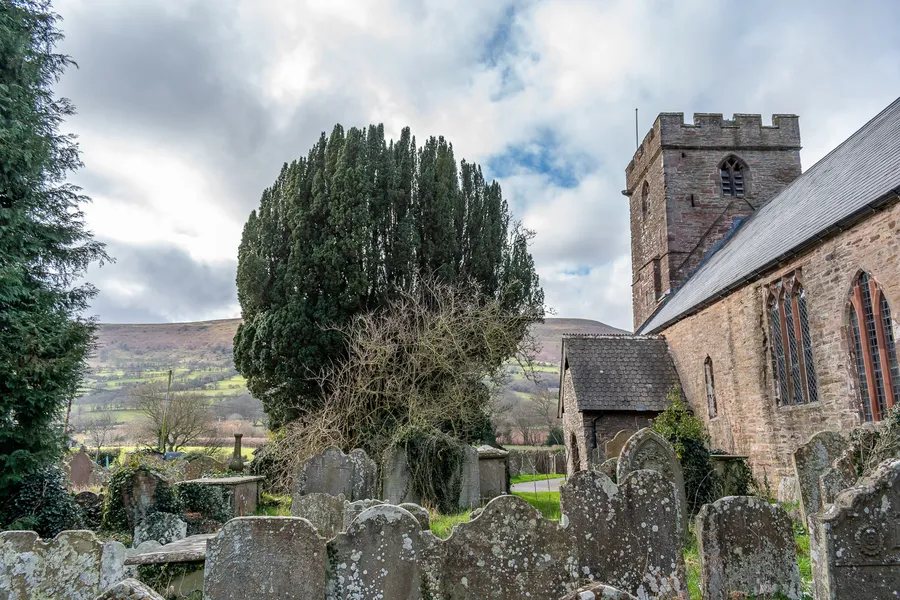
From Llanthony you can either ascend straight up to the Hay Bluff ridge with panoramic views (which shaves off a couple of miles too), or continue along the valley floor towards Capel-y-ffin, a magical Mary church in a circular churchyard (denoting often bronze age burial sites) ‘squatting like a stout grey owl among seven great black yews’ as the diarist Francis Kilvert relates. This was an ancient place of pilgrimage, its name meaning ‘chapel at the border’ – it seats just 20 people. Visitors have included Dorothy and William Wordsworth, Allen Ginsberg, Bruce Chatwin, David Jones and Eric Ravilious (who painted it), and in the adjacent monastery Eric Gill designed the typefaces Perpetua and Gill Sans.
From Capel-y-ffin, you retrace your steps to the bottom of the ascent up Hay Bluff at Nant Vision, where a vision of the Virgin Mary was seen by monks and local farm boys. The way is steep but rewardingly breathtaking. When you reach the top of Hay Bluff, you quickly start descending towards the enchanting Olchon Valley, another Shire-like valley, to Cae Mabon well which is an oasis of crystal and sparkly waters bubbling up from the roots of an old tree, permeated by an angelic energy of peace. Spend good time here before skirting round the bottom of Black Hill, and walking along the low ridgeline overlooking the Monnow Valley, you approach the foodie-loved Bull's Head pub of Craswall. Then perhaps visiting Chapel House Farm to buy some local perry and other delicious produce and St Mary's Church with its own ‘Sanctuary’ yurt tent for low-cost pilgrim accommodation. After a moment of silence in this working church, it just leaves the final approach up to Craswall Priory, the oldest, highest and remotetest Grandmontine Priory in England, now in ruins and nestled within a valley delta of springs that form the source of the River Monnow, an austere place to have been a monk but one that feels fitting as an end to this remote pilgrimage route, and also one loved by an Idler favourite, Rowan Williams, who is a regular pilgrim here.
Article first appeared in Idler magazine.
Travel
Travel is not simple without a car, and even with a car there are only two spaces by Cae Mabon well or parking at top of hill, if you turn left at the church and locals use them from time to time. There is an official car park at Pont Cadwgan, but 2.2 miles (1hr) walking away. If you are not travelling by car, you can get a train to Abergavenny and then a taxi from there. Whichever way you do it, it's all worth it to be in this incredibly remote region, because the logistical downsides are vastly outweighed by the secluded peace you will experience over the two days.
At the end at Craswall Priory, organise your car pickup for up the hill from the Priory, as it is a privately owned ruin to which the landowners kindly allow public access without charge as long as it is only accessible by walking.
Accommodation
We recommend you lodge at one of the various accommodation sites around Llanthony Priory (Hotel & B&Bs) at the end of the first day, and perhaps at Craswall (pub 'pods', Chapel House camping site or St Mary's Church’s ‘Sanctuary’ yurt tent, accessible via our website) at the end of the second day if you don't want to travel back that evening.
Route highlights


Location

Nearby Places




Discover holy places, and bring your own beliefs.
Pilgrimage by foot is connected with places and landscape, and how those places make you feel. Read about holy places.
At the British Pilgrimage Trust, we believe a pilgrimage should be made on an individual’s own terms. We are founded on the principle that we can all bring our own beliefs to the journey, accessible and welcoming to all.


Comments
0 Comments
Login or register to join the conversation.
Tom Jones
Lorem ipsum dolor sit amet, consectetur adipiscing elit. Suspendisse varius enim in eros elementum tristique. Duis cursus, mi quis viverra ornare, eros dolor interdum nulla, ut commodo diam libero vitae erat. Aenean faucibus nibh et justo cursus id rutrum lorem imperdiet. Nunc ut sem vitae risus tristique posuere.