.svg)

About Rogation: The Ancient and Evolving Tradition
10
May
,
2026


About Rogation: The Ancient and Evolving Tradition
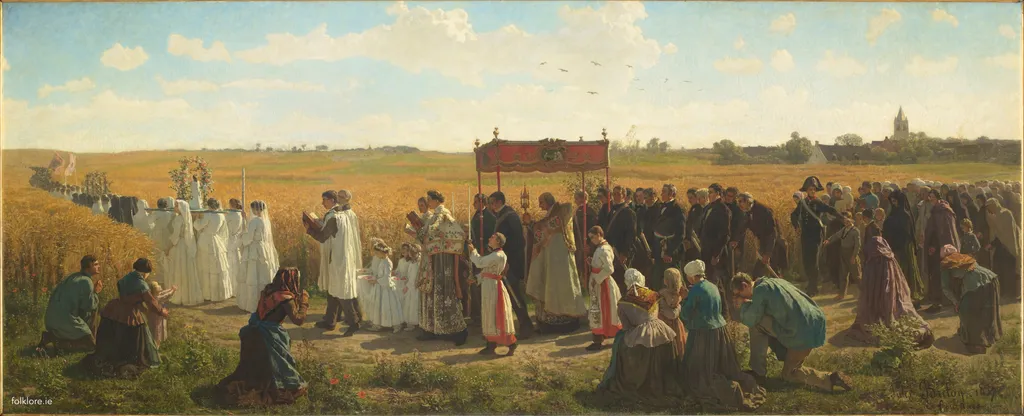
From the Latin rogare, meaning "to ask," Rogation is the festival that marks the blessing of the land to bring forth good growth. For centuries, parish communities have observed Rogation Sunday as a time to seek blessings both for the land's bounty and for the community's collective wellbeing.
Rogation dates back to at least the late 5th century, with its observance formally mandated across Anglo-Saxon England in 747 AD. Traditionally, Rogation processions sought divine blessings for the land, marking boundaries and offering prayers for agricultural success and protection.
Read about our charity's campaign to revive the ancient practice of Rogation in church communities across Britain.
More than boundaries
Rogation has never been solely about territorial boundaries. It can be understood as an engagement with spiritual boundaries — a way of interacting with the relationship between humans and the natural world. Processions did not merely walk parish lines; they visited sites of sacred power in the landscape that had been woven into Christian tradition, such as holy wells, sacred trees and landmark boulders. This is the practice often known as "beating the bounds": a parish pilgrimage.
The functions of Rogation are diverse yet interconnected: prayers for the safety and success of a community; the marking out of a parish or spiritual territory; processions between spiritually significant sites; and blessings for newly planted fields and communal outdoor spaces.
While walking the entire parish boundary remains a known practice, Rogation can just as meaningfully take place around a churchyard, a local park, a farm, or other communal spaces.
Symbols and offerings in Rogation liturgies
Several rituals from the Anglo-Saxon tradition enrich the observance of Rogation. One ancient practice, recorded in the Æcerbot ritual, involves weaving crosses from natural materials and planting them at the edge of fields or gardens. A Brigid's Cross, traditionally woven from rushes or reeds, would be especially fitting for revival today.
Other meaningful offerings in a Rogation service could include:
- Money – representing tithes and regular offerings
- Bread – ideally home-baked, symbolising sustenance and community
- Wine – a simple table wine, connecting the earthly and the sacred
- Soil – presented in a wooden or earthenware bowl, symbolising the land's fertility
- Water – in a clear vessel, reflecting the purity and necessity of life-giving water
- Seed – a collection of seeds, loose in a bowl or packaged, to be blessed for future planting
- Crosses – small wooden, reed, or paper crosses, carried and blessed as part of the procession
When is Rogation Sunday?
Rogation Sunday is a movable feast. It falls on the fifth Sunday after Easter — the Sunday before Ascension Day — so the date shifts from year to year, but always lands in spring, usually in May. The three days that follow it, Monday to Wednesday, are the traditional Rogation Days, leading up to Ascension. In 2026, Rogation Sunday fell on 10 May.
Rogation for today — community, warmth and hospitality
By reclaiming these practices, Rogation can once again become a deeply communal and inclusive occasion, blending the rhythms of ancient tradition with contemporary environmental and spiritual awareness.
Rogation is an invitation to step outside — to pray not only for the land but for the entire community: the parish and its footpaths, fields, pastures, woods, gardens, orchards, tools, seeds, crops, plants, animals and people. Everyone is welcome, always — those who attend church and those who do not. In this way it aligns with our own bring your own beliefs ethos.
This summary draws on Nick Mayhew's Landscape Liturgies: Outdoor worship resources from the Christian tradition
Each spring the British Pilgrimage Trust offers grants to help parishes revive Rogation in their own communities. See this year's campaign and reports →

Further reading


.svg)
Comments
0 Comments
Login or register to join the conversation.
Tom Jones
Lorem ipsum dolor sit amet, consectetur adipiscing elit. Suspendisse varius enim in eros elementum tristique. Duis cursus, mi quis viverra ornare, eros dolor interdum nulla, ut commodo diam libero vitae erat. Aenean faucibus nibh et justo cursus id rutrum lorem imperdiet. Nunc ut sem vitae risus tristique posuere.
Tom Jones
Lorem ipsum dolor sit amet, consectetur adipiscing elit. Suspendisse varius enim in eros elementum tristique. Duis cursus, mi quis viverra ornare, eros dolor interdum nulla, ut commodo diam libero vitae erat. Aenean faucibus nibh et justo cursus id rutrum lorem imperdiet. Nunc ut sem vitae risus tristique posuere.