

Hecate's Night – 16 Nov: the crossroads goddess who carries the torch
16
Nov
,
2026


Most of us meet Hecate in Macbeth, scolding the witches on a heath. That is the last chapter of a long story. For most of her history Hecate was something stranger and kinder: the goddess of doorways and crossroads, who carried a torch for travellers and could pass between this world and the next.
That makes her, of all the ancient gods, perhaps the closest to the pilgrim. Every pilgrimage begins at a threshold, meets a crossroads and walks for a while in the dark.
Hecate's Night on 16 November is a modern observance; the Athenians honoured her at every dark moon. But it is a good night to tell her story, drawn from a lecture by BPT patron Professor Ronald Hutton, with a short lantern pilgrimage to make tonight and places in Britain where her old concerns still live.
Who was Hecate?
Hutton's Gresham College lecture, Hecate: Mistress of Magic (November 2025), follows her through more than a thousand years of change.
She began in Caria, in what is now south-western Turkey, as the region's dominant goddess: a protector who presided over life and death. Greek settlers on that coast took her into their own religion, and around 700 BCE the poet Hesiod wrote that Zeus had given her a rare right to act in every realm of the cosmos: sky, earth and underworld.
Her name is Carian, a lost language, so nobody knows what it meant. To Greek ears it sounded like their word for "hundred", so she became a goddess of plenty and success. Because she could cross between realms, she also took travellers into her care, guarding roads and gateways. Early images show her holding a key. As she merged with Artemis, huntress of wild places, she gained the torches and hounds that became her signature.
Why is Hecate the goddess of crossroads?
In the fifth century BCE, the Athenians began to show her as triple: three figures back to back, each facing a different road. Wherever three ways met, Hecate could watch every approach. The Romans called her Trivia, "of the three ways", which gives us the word "trivial": the junction is the most ordinary place there is.
Hutton is clear that this triple form was about roads, not the Maiden, Mother and Crone of modern goddess spirituality. In Roman times her three faces were linked with the phases of the moon, and that, much later, inspired Robert Graves's triple goddess.
Crossroads were already uncanny places, where spirits and the restless dead were thought to gather. The dark of the moon became Hecate's time, and Athenian households left suppers for her at the crossroads and cleansed their homes. By the late fifth century BCE, darkness, ghosts and crossroads had made her the patron of magic: magicians were believed to need her permission to call up spirits.
How did a goddess of darkness become a bringer of light?
Here Hutton's story takes its most surprising turn. In late antiquity, a small group of pagan philosophers, the Neoplatonists, practised theurgy: rites meant to bring human beings into direct contact with the gods. They made Hecate their favourite, because a goddess who travelled between worlds was the perfect go-between. She became Hecate Soteira, Hecate the Saviour, patron of initiation and transformation. They pictured her as "a pure and formless fire from which a voice issued", coming down to give wisdom.
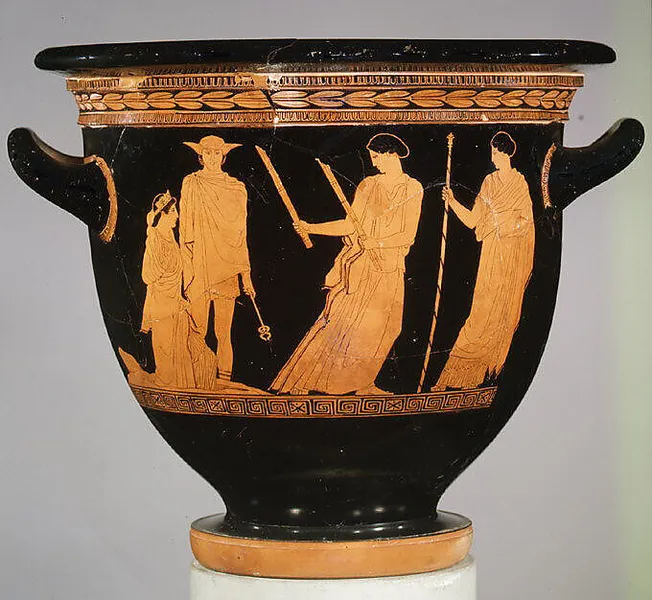
That turn was there from the start. In the Homeric Hymn to Demeter, when Persephone is carried off to the underworld, Hecate hears her cry, meets the grieving Demeter with a torch in her hands and goes with her to find the truth. When Persephone returns, Hecate becomes her companion. On the Greek vase at the top of this page, painted around 440 BCE, she walks ahead of Persephone, lighting her way up out of the dark with two torches.
Should we tame Hecate?
Having rescued Hecate from Macbeth, it is tempting to make her a gentle spirit of self-improvement. The mythographer Marina Warner offers a useful warning. Her 1994 Reith Lectures, Managing Monsters, opened with the she-monster of myth, from Medea, Hecate's priestess, to the velociraptors of Jurassic Park. She asked how such figures express and shape our attitudes to women. In 2022, reviewing the British Museum's exhibition Feminine Power, whose catalogue placed Hecate among the witches and demonesses, she welcomed the reclaiming of reviled goddesses. But she cautioned that if every frightening figure were rehabilitated, "the divine and demonic powers at issue would be weakened".
Hutton's Hecate bears this out: she kept her protective side even as her darkness grew. Shakespeare knew both faces. His Hecate rules the witches in Macbeth (though her main scene may be by Thomas Middleton), yet in A Midsummer Night's Dream the fairies run "by the triple Hecate's team", and Lear swears by "the mysteries of Hecate and the night". Her gift to the traveller is the torch, not the absence of night.
How can I mark Hecate's Night?
You don't have to believe in Hecate to keep her night: as with any pilgrimage, bring your own beliefs. These practices are inspired by her stories, not reconstructions of ancient rites.
A lantern pilgrimage to the crossroads
- Choose your crossroads. A fingerpost on a green lane, a meeting of paths in a wood, a junction by a churchyard; a three-way junction is Hecate's own. Go with a companion or somewhere you feel safe, and carry a head torch as well as a lantern.
- Mark the threshold. Before you leave, pause on your doorstep with a hand on the door frame. Say aloud where you are going, and why.
- Walk in silence. Keep your phone in your pocket and let your eyes adjust. Tonight's moon is a waxing crescent, a little under half lit.
- Face each road. At the crossroads, turn to each way in turn, as Hecate's three faces did, and hold one question for each. What am I leaving behind? What uncertainty am I facing? What might open up if I stepped forward without knowing the outcome?
- Make an offering. Athenians left food at the crossroads. Leave nothing that litters or harms wildlife: sing a verse instead, or give thanks for safe journeys, your own and those of people you love.
- Come home. Walk back without speaking. Cross your threshold deliberately, and light a candle inside.
Other ways to keep the night
- Sweep your doorstep. Athenians cleansed their homes at the dark of the moon. Clear your step, wipe your door, and think about what you let in.
- Share a Hecate's supper. Cook something simple, set a place for an absent friend or a stranger, and give the cost of a portion to a food bank or night shelter.
- Wait for the dark moon. The next falls on the night of 8 December, before the new moon of the 9th. Walk to your crossroads again then, at the time the Athenians honoured her.
Where can I find Hecate in Britain?
There is no ancient Hecate shrine to walk to in Britain. But the things she watched over are everywhere: thresholds, crossroads, wayside guardians, black dogs and black poplars. None of these places was dedicated to her. They are echoes, not inheritance, but each makes a fine destination for a winter pilgrimage.
- The Arbor Tree, Aston on Clun, Shropshire. A black poplar beside a stream where four roads meet, dressed with flags each May and left flying all year. In Roman times, Hutton notes, the deep-rooted black poplar was one of Hecate's trees.
- Holy Trinity, Blythburgh, Suffolk. On 4 August 1577, the story goes, a great black dog burst into the church during a storm, the same day it terrified St Mary's, Bungay. Scorch marks on the north door are still called the devil's fingerprints. Hecate's hounds were the black dogs of the Greek night; East Anglia has its own. Some researchers think marks like these were burned deliberately with a taper to protect the doorway.
- Any lychgate. The roofed gate where a coffin rested on its way into the churchyard (lych is Old English for corpse) is Britain's commonest threshold between the living and the dead.
- Durham Cathedral's north door. Its bronze sanctuary knocker (a replica; the 12th-century original is inside) once promised protection to anyone who reached it.
- St Christopher wall paintings. Medieval churches often painted him opposite the door, because one glimpse was thought to keep a traveller from sudden death that day. Pickering in North Yorkshire has a fine example: a Christian guardian of travellers, keeping watch at the threshold.
- Dartmoor's wayside crosses. Granite crosses set up in the Middle Ages to guide travellers across the open moor, waymarks for walking safely through uncertain country.
The goddess who carries the torch
Hecate's long career, from guardian of travellers to mistress of magic to guide towards divine light, says something pilgrims learn on the road. The unknown is not only something to fear. You leave the safety of what you know, reach a crossroads, choose without being sure, and walk on into the dark. Hecate does not take the darkness away. She carries the torch.
Further reading
- Ronald Hutton, Hecate: Mistress of Magic, Gresham College lecture and transcript, 2025
- Sarah Iles Johnston, Hekate Soteira (1990), the study Hutton recommends
- Marina Warner, Managing Monsters: Six Myths of Our Time, the 1994 Reith Lectures
- Marina Warner, 'Goddesses, I yield to you!', The Guardian, 16 May 2022
- BPT: What is pilgrimage? and How to plan and start your pilgrimage
Banner: bell-krater attributed to the Persephone Painter, Athens, c. 440 BCE. The Metropolitan Museum of Art, Fletcher Fund, 1928. Public domain.

Further reading


Comments
0 Comments
Login or register to join the conversation.
Tom Jones
Lorem ipsum dolor sit amet, consectetur adipiscing elit. Suspendisse varius enim in eros elementum tristique. Duis cursus, mi quis viverra ornare, eros dolor interdum nulla, ut commodo diam libero vitae erat. Aenean faucibus nibh et justo cursus id rutrum lorem imperdiet. Nunc ut sem vitae risus tristique posuere.