.svg)

Historic First: Archbishop walks pilgrimage to Canterbury enthronement
18
Mar
,
2026
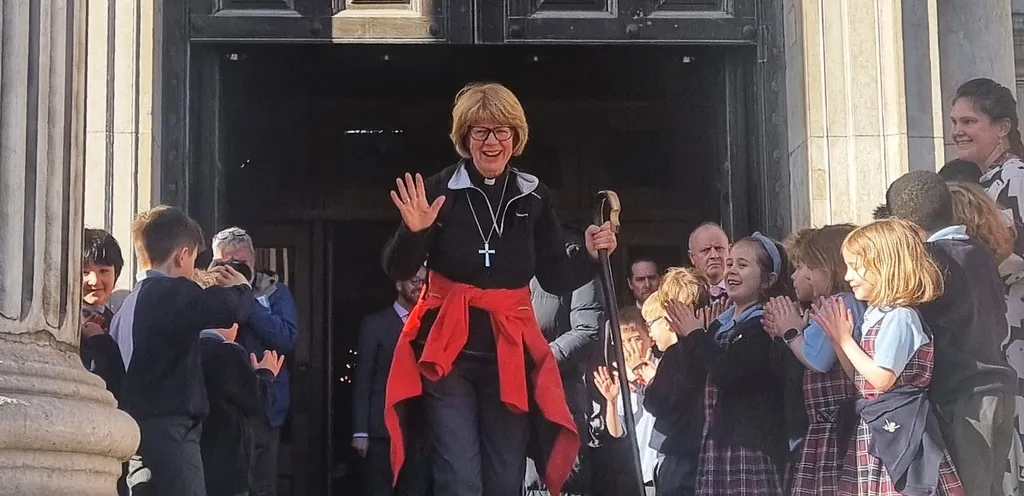


We join the Archbishop of Canterbury on pilgrimage
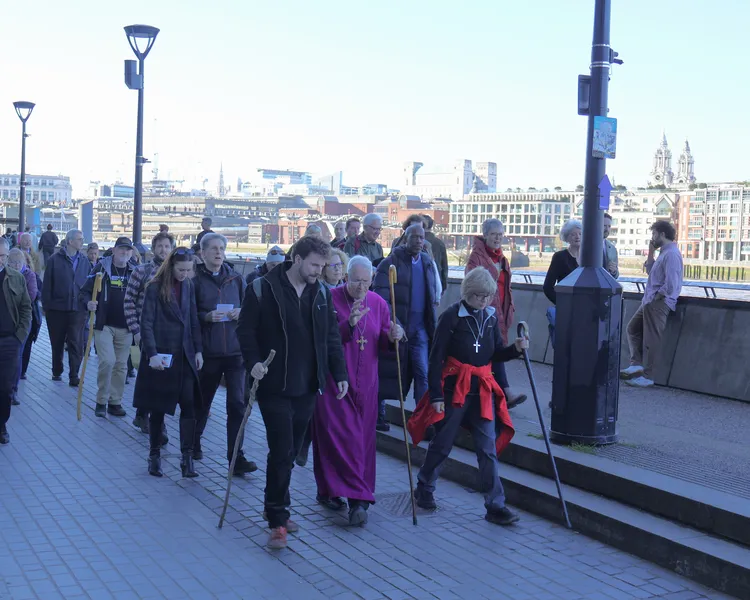
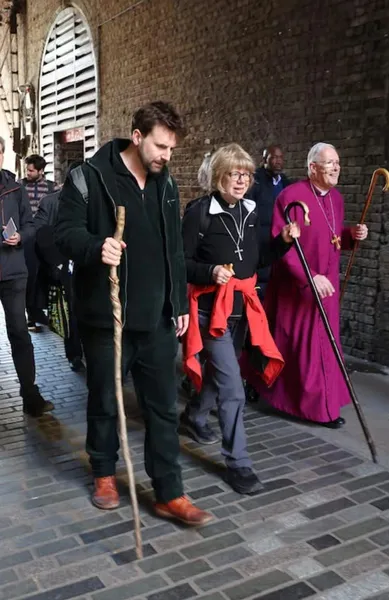
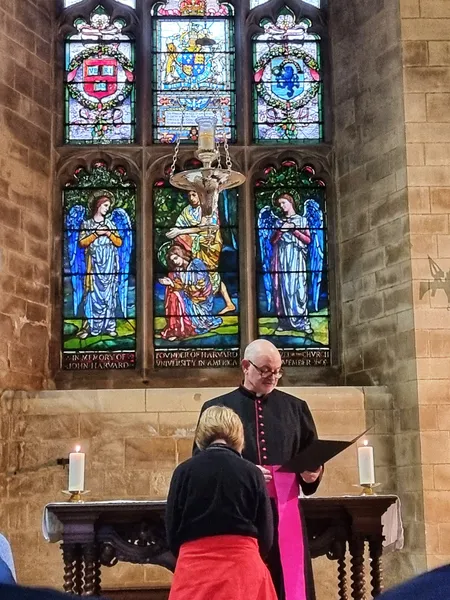
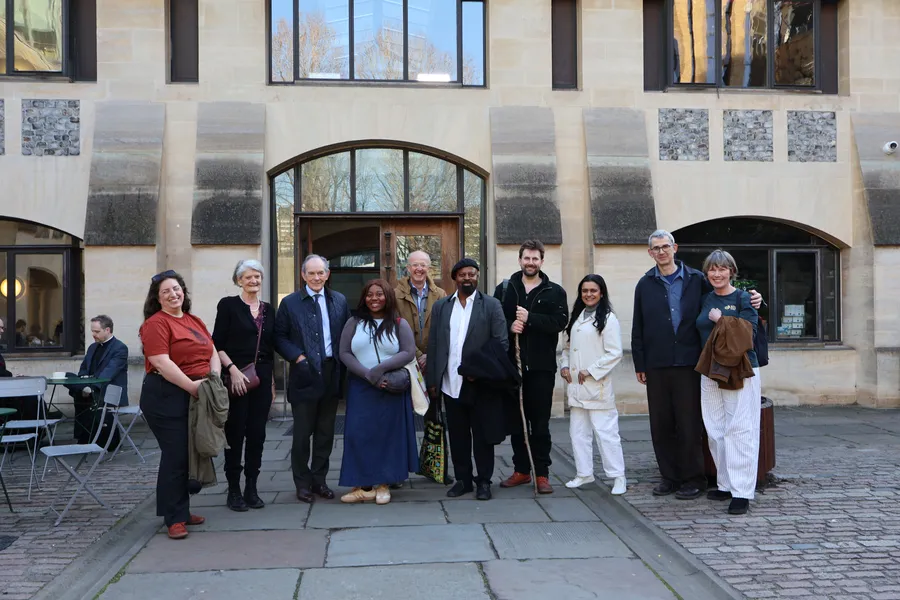
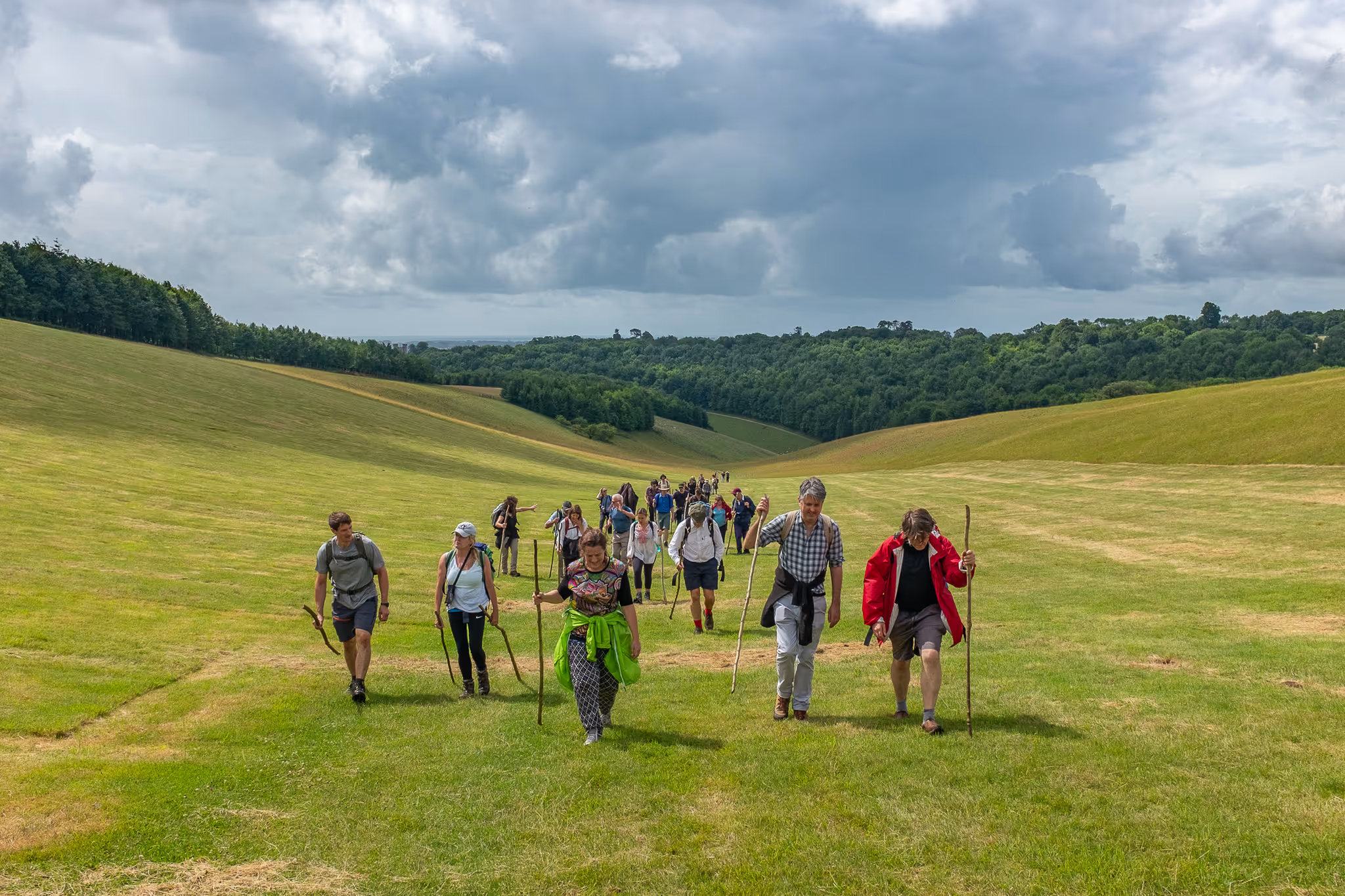
It’s a Tuesday and the buses are hooting, the financiers are drinking their coffee, and the City of London is going about its business. Yet among this bustle, the Archbishop of Canterbury is leaving the south portico of St Paul’s Cathedral after a short 'Blessing of the Pilgrims' sending off service in which wooden staffs were blessed. She will be walking with her husband, her chaplain Richard Braddy and the pilgrimage officer of Canterbury Cathedral, Torin Brown, for the start of her six-day pilgrimage. She is also joined by the British Pilgrimage Trust’s team, trustees and patrons (see photo at bottom). There are forty schoolchildren hip-hip hooraying her, many top brass of the church and a bank of press photographers too. Everyone knows what is about to happen is a historical turning point. Yet on the surface it is simply a humble scene of a group setting out on a walk.
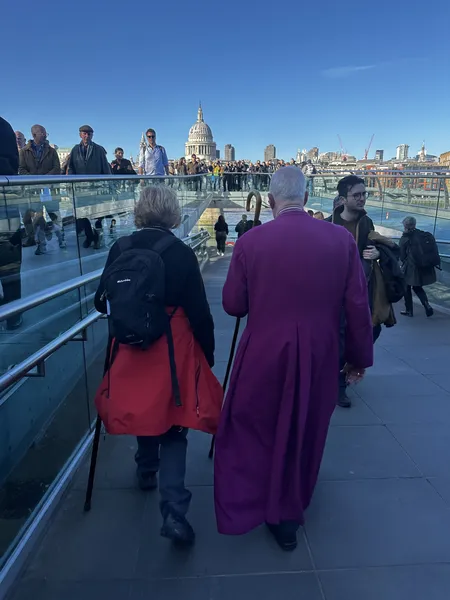
Walking with the Bishop of Southwark
England once had a thriving pilgrimage culture in the medieval period. Canterbury Cathedral was a major destination for centuries, and sections of its building as it now stands were paid for by wealth amassed from pilgrims. They were coming in their droves to visit the shrine of Thomas Becket who, as Archbishop, had been martyred in the cathedral in 1170. Chaucer’s Canterbury Tales written in 1392 was inspired directly by the lived reality of pilgrimage shaping the religious and social life of the time.
But this all changed in the Reformation of the 1530s, owing to King Henry VIII and his right-hand man Thomas Cromwell who banned pilgrimage in a 1538 injunction, just as the Church of England was being established. Cromwell declared that Henry VIII’s subjects should not “repose their trust and affiance in any other works devised by men’s phantasies besides Scripture; as in wandering to pilgrimages, offering of money, candles, or tapers to images or relics, or kissing or licking the same”. In addition, the vital infrastructure of pilgrimage was destroyed – long-revered relic shrines and monasteries – and vagrancy laws were introduced, and so the practice never fully recovered in the Church of England. As a result, not only was a religiously devotional practice lost but so was the birthright experience of leaving your parish to purposefully travel toward meaningful places.
The Archbishop of Canterbury will be approaching Canterbury on foot in the lead-up to her installation (also called enthronement), and none of her predecessors have, perhaps, ever done this before. Setting what biologist Rupert Sheldrake calls a “wonderful example”, Dame Sarah Mullally will be walking six days and 87 miles humbly as a pilgrim, meeting both those she has planned to meet, including schoolchildren, and whomever happens to come across her path, traversing diverse landscapes and arriving at Canterbury Cathedral to conclude with the musical service of choral evensong.
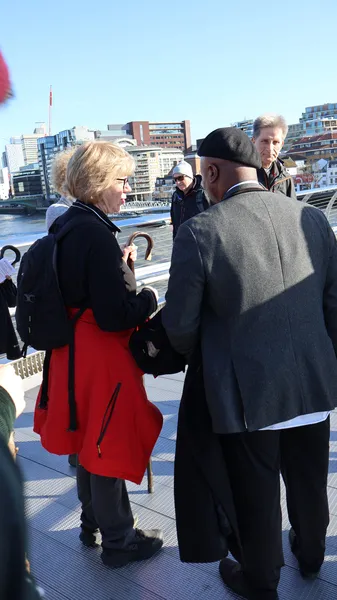
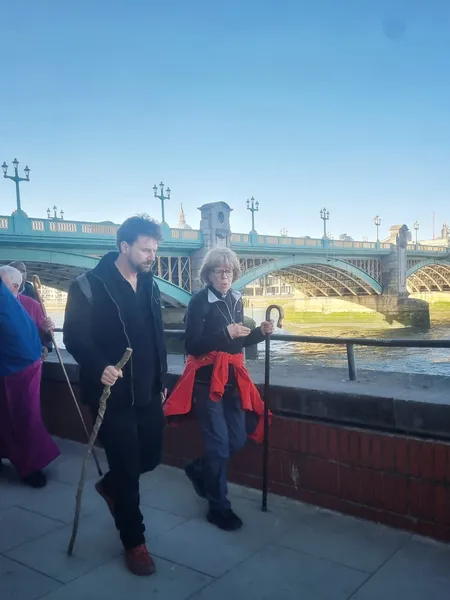
I walk with her for a while on the approach to Southwark Cathedral, after crossing Millennium Bridge, and ask her why she has decided to be so historic? She says: "for prayerful reflection, to walk in the footsteps of my predecessors Becket and Geoffrey Fisher, and to encounter people along the way on their own journeys with faith". Walking with each other is a big feature for her as she places such importance on community, saying that it is a defining feature of Christianity. She also hoped this pilgrimage would inspire others to do the same, and was looking forward to the special feeling of arriving on foot to her big ceremony. She said she had had a taste of this when walking to Rome to arrive in time for the pope's inauguration ceremony last year.
The route from London’s St Paul’s Cathedral to Canterbury Cathedral is particularly fitting given she was previously the Bishop of London. This fact makes it a literal rite of passage towards her new post. This route, known as the ‘Becket Camino - Southwark to Canterbury’ can be followed along the Thames Path, the Via Britannica and the Augustine Camino.
The Archbishop’s decision to undertake this pilgrimage just as she steps fully into her new role also comes at a crucial time within the Church of England. Like many historic institutions, the Church has been reflecting on how it can reconnect with people in a rapidly changing society. Church attendance has declined over recent decades, and there is a growing recognition that the average person’s spiritual life today is not merely confined to the inside of traditional church buildings.
Pilgrimage, which is a journey to a place of meaning, undertaken with intention and attention, rather than distance as the defining feature, offers a simple but powerful response. It allows people to explore matters of the heart not only inside buildings but outdoors in fields, woodlands, along rivers, villages, city streets and by ancient trees and holy wells. Dame Sarah beginning her term as Archbishop on foot carries a message, and image, of humility: that the Church is willing to step out of its centuries-long comfort zone, and rediscover an ancestral expression of faith, venturing into the unknown, as pilgrims have always done.
The Archbishop’s decision to walk this rite of passage also reflects a rise in pilgrimage that has been unfolding across the world. In Europe, routes such as the Camino de Santiago in Spain, Via Francigena from Lucca to Rome, which Dame Sarah has also walked in 2025, and St Olav’s Way in Norway, now attract hundreds of thousands of walkers each year, while here in Britain, old ways to, for example, Canterbury, Glastonbury, Stonehenge, Lindisfarne, Iona and St Davids are being rediscovered and restored, along with many others spread across this island. The British Pilgrimage Trust recently commissioned a YouGov survey and found that 3.7 million British adults have already completed a pilgrimage, and close to eight million, nearly one in five – are considering making one.
In a world defined by speed, screens and digital ‘connection’, pilgrimage offers the opposite: time for the slowness of shared, lived memories to unfold through moving and feeling with our bodies. The poet Ben Okri calls the Archbishop’s journey a “radical” and “doubly moving” act”: Dame Sarah is not only the first woman to ascend to that position, she is also restoring “the spirit of ritual” and reminding people of “the difference between a life of purpose and a life of distraction.” Okri hopes others will be inspired to embark on “pilgrimages of their own” across the country.
What is striking about how pilgrimage is practiced today is the range of reasons that pilgrims give for setting out. Some walk for their explicit faith, others from simple curiosity, painful grief, artistic inspiration or simply the desire to spend time in the landscape. Pilgrimage offers a rare kind of shared space in which people with different beliefs and backgrounds can walk together without needing to resolve their differences first; i.e. a practice not a belief system.
This is significant at this time of need for safer intercultural dialogue. That openness and tolerance has always been central to the work of the British Pilgrimage Trust I co-founded in 2014. We have always encouraged everyone to “bring your own beliefs” to the footpath, and let the journey work on you. Many who set out would not describe themselves as religious, yet feel that the pilgrimage still has spiritual meaning by engaging with something larger than themselves.
Many of those invited to join on this special day see the Archbishop’s journey as resonating far beyond the Church itself. Simon Jenkins, himself without faith, said he favours ‘walking with a purpose’. The environmental thinker Satish Kumar describes Dame Sarah’s gesture as a reminder that “we need to live as pilgrims rather than tourists,” seeing it as “a testament of humility and renewal in the spirit of pilgrimage.” The historian Luke Sherlock, known as @englishpilgrim by hundreds of thousands of followers on social media, finds it inspiring to see the Archbishop turning “quite literally, to the old ways” of pilgrimage that have sustained “the spiritual life of this island since before our nations were forged.”
As the Archbishop and her fellow pilgrims set out on the path to Canterbury yesterday, 17th March 2026, weaving together, in Dame Fiona Reynolds' words, “place, people and thought” , they join a powerful path, that has shaped this island for nearly a thousand years since Thomas Becket’s martyrdom. Yet for centuries the path has been neglected. Now, once again, pilgrims are returning.
***
Dr Guy Hayward is Director and Co-Founder of the British Pilgrimage Trust and Choral Evensong Trust, and is co-author of ‘Britain’s Pilgrim Places’.
Other press on this story
New archbishop to walk from London to Canterbury for installation. First time in modern history.
Radio 4 PM programme with Alice Loxton
Telegraph article bulletin
Telegraph article 2 by Catherine Pepinster
Telegraph article 3 by Alice Loxton
Church Times article by Sarah Meyrick

Further reading



.svg)
Comments
0 Comments
Login or register to join the conversation.
Tom Jones
Lorem ipsum dolor sit amet, consectetur adipiscing elit. Suspendisse varius enim in eros elementum tristique. Duis cursus, mi quis viverra ornare, eros dolor interdum nulla, ut commodo diam libero vitae erat. Aenean faucibus nibh et justo cursus id rutrum lorem imperdiet. Nunc ut sem vitae risus tristique posuere.
Tom Jones
Lorem ipsum dolor sit amet, consectetur adipiscing elit. Suspendisse varius enim in eros elementum tristique. Duis cursus, mi quis viverra ornare, eros dolor interdum nulla, ut commodo diam libero vitae erat. Aenean faucibus nibh et justo cursus id rutrum lorem imperdiet. Nunc ut sem vitae risus tristique posuere.