

St Giles' Church, Oxford
St Giles' Church, Woodstock Road, Oxford OX2 6HT


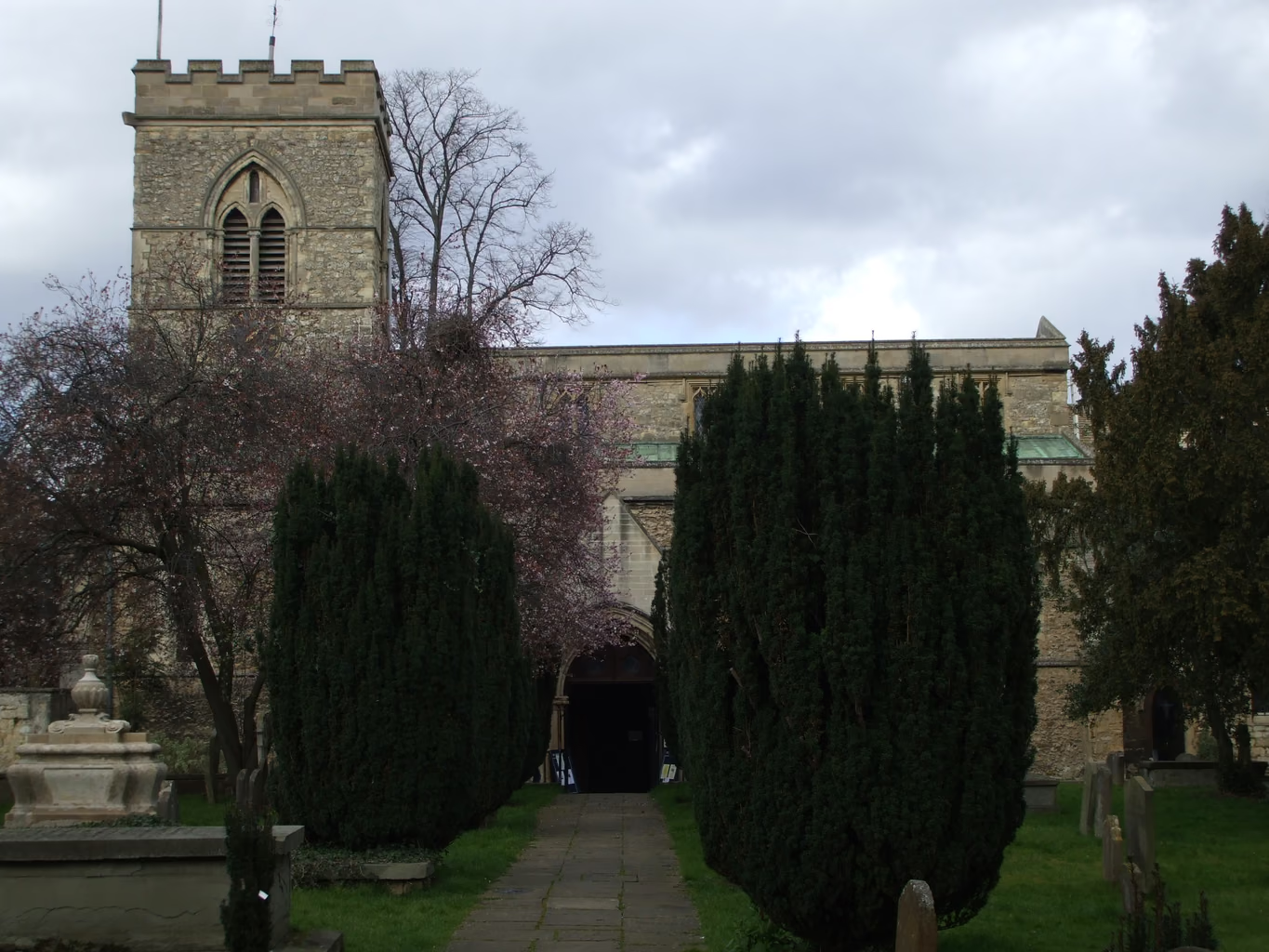

Outside the North Gate, where the Four Gates pilgrimage enters Oxford
Highlights
- Twelfth-century fabric surviving in the clerestory and the lower tower
- Consecrated in 1200 by St Hugh of Lincoln
- St Giles’ Fair, which still closes the street every September
St Giles stands beyond the line of Oxford’s medieval north wall, on the fork where the Woodstock and Banbury roads divide. St Giles is the patron of lepers, beggars and the disabled, and his churches were built at the edges of towns, by the gates, on the ground where such people were required to remain. Pilgrims walking the Four Gates route meet St Giles before they meet the city.
The church was probably built as a private church by Edwin, son of Godegose, somewhere between 1123 and 1133, to serve a large and thinly populated parish running from Walton Street across to the Cherwell. It was not consecrated until 1200, by Hugh, Bishop of Lincoln, in the year of his death. Two windows in the north clerestory and the lower stage of the bell tower survive from that first church; the aisle arcades and lancets are Early English, and the chancel is late thirteenth-century Decorated. The church is listed Grade I.
St John’s College has held the patronage since the sixteenth century, from the college’s own founder, Sir Thomas White. During the Civil War siege of Oxford the church was used to hold parliamentary prisoners, who burned its furnishings in 1643. As the city spread north the huge old parish was carved up around it — Summertown in 1834, St Paul’s in 1837, St Philip and St James in 1863 — and the churchyard was closed to burials in 1848.
St Giles Fair
The fair outside the door is the thing most people know, and its origins are humbler than the usual telling. It grew out of the parish wake, the patronal celebration first recorded in 1624 and long known as St Giles’ Feast, held in the churchyard on St Giles’ Day and the week after. By the 1780s it was a toy fair selling cheap and useful goods; by 1800 a general fair of stalls and rides; from the 1830s a byword for rowdiness, with excursion trains bringing crowds from distant cities. Oxford City Corporation took formal control in 1930. It is held on the Monday and Tuesday after the first Sunday following St Giles’ Day — in 2026, 7 and 8 September — when the whole broad street is closed and given over to it. Read more about the fair on the Oxford City Council's website.
Directions
St Giles’ Church, Woodstock Road, Oxford OX2 6HT
GPS: 51.7593N 1.2605W
At the north end of St Giles’, where Woodstock Road and Banbury Road divide, about ten minutes’ walk north of Carfax. Generally open Monday to Friday 12pm–2pm and 5.30pm–6pm, Saturday 5.30pm–6pm, and on Sunday around services. Entry free.
Amenities
Key facts
Britain’s Pilgrim Places
This listing is an extract from Britain’s Pilgrim Places, written by Nick Mayhew-Smith and Guy Hayward and featuring hundreds of similar spiritually charged sites and landscapes from across Britain.
Proceeds from sale of the book directly support the British Pilgrimage Trust, a non-profit UK charity. Thank you.
Location
Nearby routes




Comments
0 Comments
Login or register to join the conversation.
Tom Jones
Lorem ipsum dolor sit amet, consectetur adipiscing elit. Suspendisse varius enim in eros elementum tristique. Duis cursus, mi quis viverra ornare, eros dolor interdum nulla, ut commodo diam libero vitae erat. Aenean faucibus nibh et justo cursus id rutrum lorem imperdiet. Nunc ut sem vitae risus tristique posuere.