.svg)

Coddiwomple, Peregrination and Pilgrimage – On the Art of Not Quite Knowing Where You're Going
23
Jul
,
2026
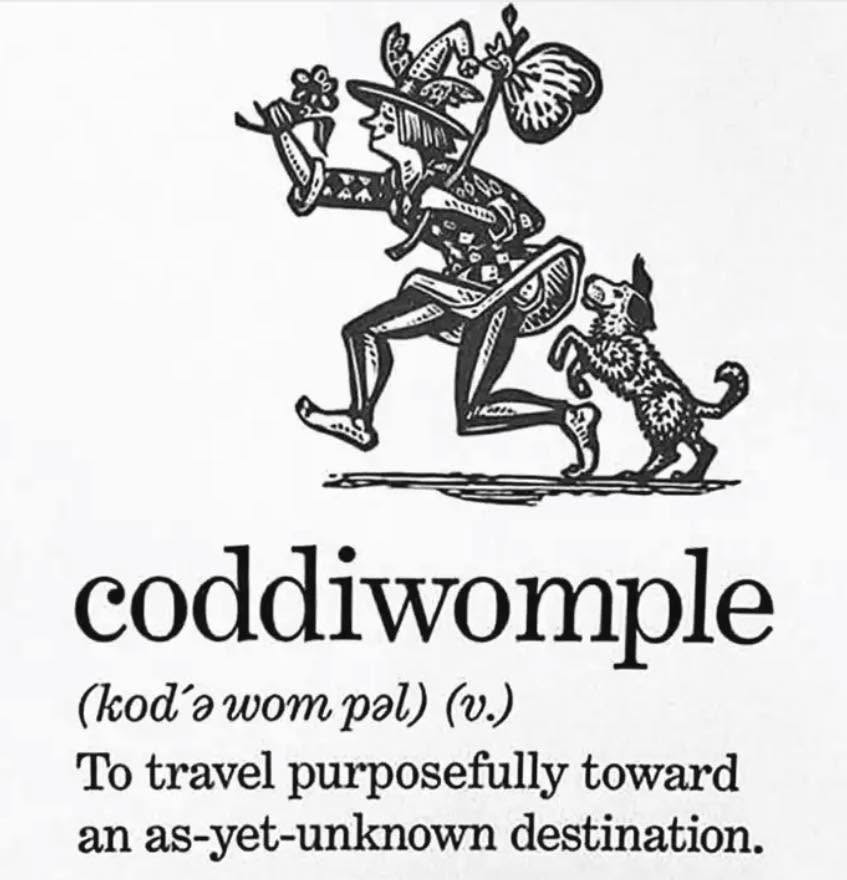


At the British Pilgrimage Trust we are the charity for pilgrimage, peregrination and coddiwompling. It is a mouthful, but the three words are all relevant. They mark out three ways of moving through the land on foot, three different relationships with that most loaded of things: a destination.
Coddiwomple means to travel in a purposeful manner towards an as-yet unknown destination. You set out with intention in your legs and something quickening in your chest, but you have not decided or cannot yet know where you will end up. Peregrination is the older, roomier word for wandering and journeying, for travelling as a stranger through the world. And pilgrimage is a meaningful journey to a place that matters, perhaps a holy place, but a known destination nonetheless.
The question that started this
I was giving a talk not long ago when someone raised a hand and asked, in effect: but what about the walk where you have no particular destination at all? Where you simply go where the wind takes you, in an aimless fashion? That, they pointed out, is quite different from the Trust's model of defined routes, routes we research, design and lay out with holy wells, hilltops, ancient churches and good songs and myths to sing and tell along the way.
What does coddiwomple mean?
Coddiwomple means to travel in a purposeful manner towards an as-yet unknown destination. It’s surprisingly a modern word. You will find it described all over the internet as "old English slang," but you will not find it in any historical dictionary. It is a whimsical coinage of recent decades that has caught on precisely because it names something we felt but had no word for. That doesn't make it less true. English has always grown this way.
What we love about coddiwompling is that it holds two things most of us keep apart. It holds purpose — you are not drifting, you are underway, there is direction and appetite in you — and it holds not knowing. That is a very different posture from the anxious modern one of booking everything in advance and arriving on schedule at a pre-defined destination. It is closer to how the old pilgrims travelled, and closer to how a life is actually lived.
What does peregrination mean?
Peregrination means a wandering, a journey, a roaming about the world. It comes from the Latin peregrinari, "to travel abroad," and behind that sits peregrinus — a foreigner, a stranger, one who comes from beyond the fields. Break the word open and you find per (through/away from) and ager (field or land): the peregrine is the one who goes away from the fields of home, past the familiar boundary, out into the wider country.
The peregrine falcon, named not for where it nests but for the fact that falconers once took it in passage — the wandering falcon, caught on migration takes it name from peregrination. The other is the pilgrim: peregrinus softened over centuries into pelegrinus and finally into our English "pilgrim." So the pilgrim and the wanderer are, etymologically, the same person. Every pilgrim is a peregrine; every peregrination has a little pilgrimage folded inside it, and the principles of peregrination are similar to pilgrimage as discussed in our interview with Satish Kumar.
Three ways of walking, one family
So here is the spectrum our three words describe, from most-defined to least:
- Pilgrimage — a known destination and a designed route. You are walking to somewhere that matters: Canterbury, Walsingham, a holy well on a Cornish cliff. The way is charged with meaning before you take a single step.
- Coddiwompling, peregrination, wayfaring or plain wandering — purpose without a fixed endpoint. You set out with intent, but the destination and path are unknown and emerge as you walk.
But isn't aimless walking just... aimless?
"Aimless" is a word we use as an insult and shouldn't. There is a long and dignified tradition of the purposeful walk without a purpose: the flâneur ambling the city; the Romantic poet loose on the fells; the ancient formula solvitur ambulando, "it is solved by walking." You do not always know what you are walking towards. Sometimes you are walking to find out what you are walking towards, which is coddiwompling by another name. And sometimes you are simply letting the land and the day lead you, trusting that being led is itself a practice worth having.
This is where our "bring your own beliefs" approach comes in. You don't need to declare a creed to feel the difference between trudging and being drawn onward. The aim of the aimless walk is to become, for a few hours or days, a person who can be surprised.
The catch: where do you sleep?
It is all very well to go where the wind takes you for an afternoon. But if you want to wander for days, the wind does not book you a bed for the night.
This is the real reason our routes are designed rather than left open. A defined route lets us know, roughly, where a walker will be at dusk — near a village with a pub, a church porch that offers a night's shelter, a friend's floor, a campsite, a spot where a farmer has said yes. Pure coddiwompling, by contrast, suits the walker who is genuinely at ease with wild camping (or its gentler cousins, bivvying and bothying) — someone content to carry their bed on their back and lie down wherever the day runs out. This is not for everyone, and it comes with responsibilities: knowing the law where you walk, leaving no trace, and choosing your ground with care and courtesy.
So the honest guidance is this. Coddiwomple freely for a day, and let the wind have you. For anything longer, either learn to wild camp well, or lean on a route with known resting places — which is precisely the scaffolding the Trust exists to provide with our Sanctuary Network. A designed route is not a cage, but one you are free to wander off, and wander back to.
How to coddiwomple well
- Pick a direction, not a destination. A hilltop you can see, a river to follow, a church tower on the horizon. Aim at that, and let the ending find you.
- Give yourself a turning-back time, not a turning-back place. Freedom needs one honest constraint to keep it safe.
- Sort your night before dusk. Either you're wild camping and equipped for it, or you're steering towards somewhere with a roof.
- Take a song. A walked tune does much for the spirit.
- Let yourself be led. The whole art is trusting that the way knows something you don't.
Why one charity holds all three
We could have called ourselves a charity for pilgrimage alone and left it there. But the truth is that the pilgrim, the peregrine and the coddiwompler are cousins, walking the same fields towards destinations that are known, unknown, or gloriously beside the point. Our defined routes are the front door; the wander is the window you can always climb out of. Both get you into the fresh air, into the land, into that old and reliable magic by which a person sets off as one self and arrives, footsore and clearer, as another.
Frequently asked questions
What does coddiwomple mean? To coddiwomple is to travel in a purposeful manner towards an as-yet unknown destination — you set out with real intent, but the endpoint reveals itself as you go rather than being decided in advance.
Is coddiwomple a real word? It is a modern, whimsical coinage rather than genuine old English, despite what much of the internet claims. But it has earned its place in the language by naming a feeling we had no other word for.
What does peregrination mean? A peregrination is a wandering or journey through the world. It comes from the Latin peregrinus, "stranger" or "one from beyond the fields" — the same root that gives us both "pilgrim" and the peregrine falcon.
What's the difference between coddiwompling and pilgrimage? A pilgrimage has a known, meaningful destination and a designed route. Coddiwompling keeps the sense of purpose but lets the destination stay unknown until you arrive.
Can you go on a wandering walk with no destination at all? Absolutely — that's peregrination in its purest form. It works beautifully for a day. For longer journeys the practical challenge is where to sleep, which suits confident wild campers or a route with known resting places along the way.

Further reading



.svg)
Comments
0 Comments
Login or register to join the conversation.
Tom Jones
Lorem ipsum dolor sit amet, consectetur adipiscing elit. Suspendisse varius enim in eros elementum tristique. Duis cursus, mi quis viverra ornare, eros dolor interdum nulla, ut commodo diam libero vitae erat. Aenean faucibus nibh et justo cursus id rutrum lorem imperdiet. Nunc ut sem vitae risus tristique posuere.
Tom Jones
Lorem ipsum dolor sit amet, consectetur adipiscing elit. Suspendisse varius enim in eros elementum tristique. Duis cursus, mi quis viverra ornare, eros dolor interdum nulla, ut commodo diam libero vitae erat. Aenean faucibus nibh et justo cursus id rutrum lorem imperdiet. Nunc ut sem vitae risus tristique posuere.